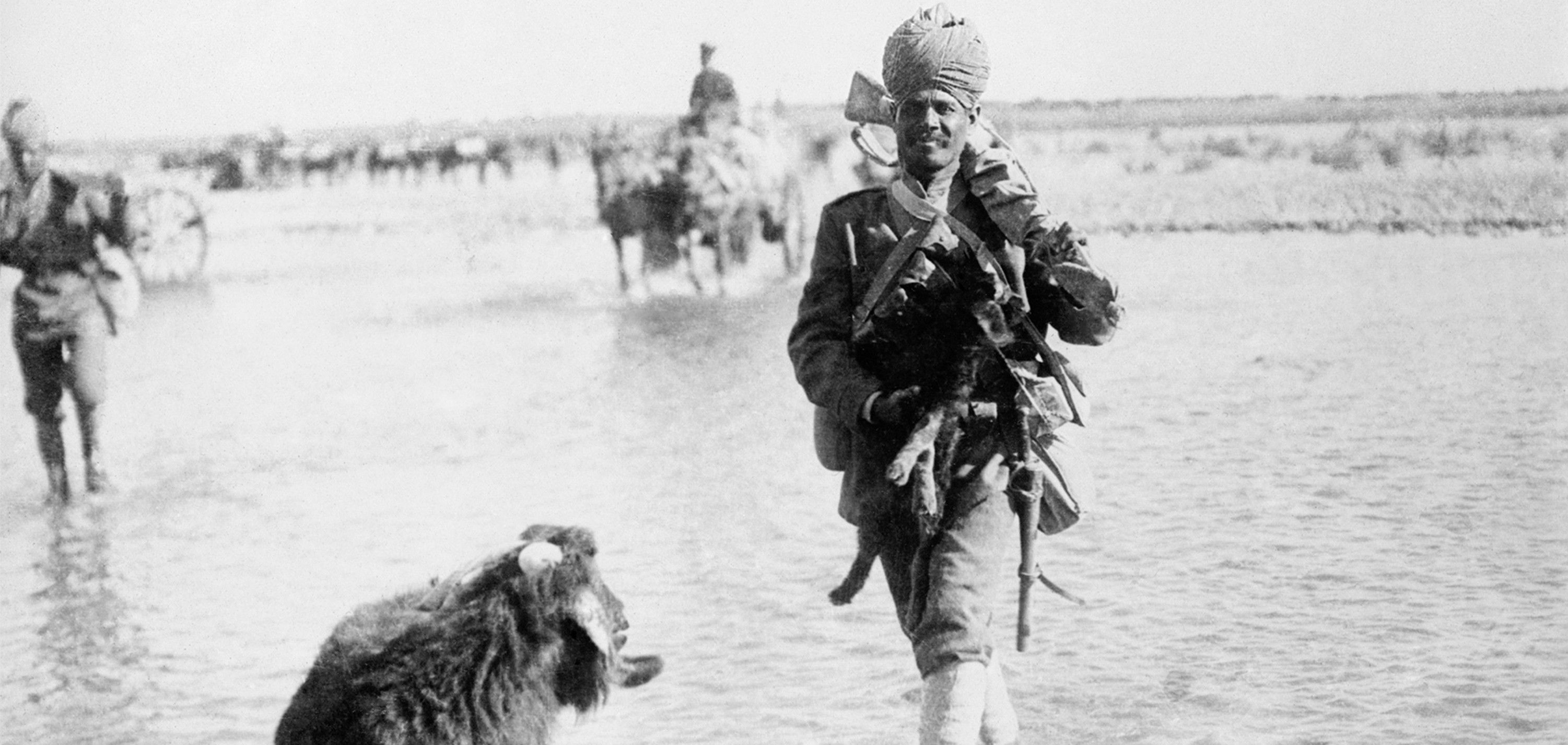
British Indian Army and the First World War
A plaintive voice, interrupted by awkward silences, crackles from an old phonograph record as the speaker narrates his life story in Punjabi:
There was a man who would have ghee (butter) back in India
He would also have two sers of milk.
He served for the British.
He joined the European War.
He was captured by the Germans.
He wants to go back to India.
If he goes back to India, then he will get that same food_.1_
This is the story of Mall Singh, an Indian prisoner of war, held in the Half-Moon Camp at Wünsdorf; he was recorded on December 11, 1916 by the Royal Prussian Phonographic Commission as part of an ethnological and linguistic study. Asked to recite a poem or sing a song, Singh ends up issuing a desperate plea; home is remembered as taste. We do not have any other information on Singh. He was one of the 1.5 million Indian troops who served in the First World War: the fragile voice-recording remains a testimony to both the poignancy and the fragmentary nature of their stories.
Of the various colonies in the French, German and British empires, undivided India (comprising today’s Bangladesh, Burma, India and Pakistan) contributed the highest number of men. The total number of Indian ranks recruited up to December 31, 1919 was 877,068 combatants and 563,369 non-combatants, making a total of 1,440,437.2 Between August 1914 and December 1919, India had sent overseas for purposes of war 622,224 soldiers and 474,789 non-combatants, pressed into one of the seven expeditionary forces: Indian Expeditionary Force (IEF) A to Europe, IEFs B and C to East Africa, D to Mesopotamia, E and F to Egypt or G to Gallipoli. Between 50,000 and 70,000 of these men were killed. They won 9,200 gallantry awards, including eleven Victoria Crosses (India, six; Pakistan, three; Nepal, two). Fighting for the empire during the first anti-colonial stirrings, these men have until recently been doomed to wander in the no man’s land between nationalist historiographies of South Asia and the Eurocentric narratives of the First World War.
The Indian sepoys (from sip__ā__hi, meaning ‘foot-soldier’) were recruited from poor peasant-warrior classes in villages spread across Northern and Central India; they were selected according to the prevalent ‘martial race’ theory, which deemed that certain ethnic and religious groups such as Pathans, Dogras, Jats, Gurkhas and Sikhs were ‘naturally’ war-like. Like the majority of their non-literate African, Caribbean or Maori brethren, they did not leave us with the abundance of testimonies that forms the cornerstone of European war memory. A photograph from the Imperial War Museum archives, showing a non-literate sepoy giving a thumb impression to accept his pay, starkly captures the hierarchies across the line of colour (Figure 1). But amnesia is not absence; memories often exist silently, stubbornly. A pair of blood-stained glasses, preserved in a former French residence near Kolkata, leads one to the trail of Jogen Sen — he was the only non-white member of the Leeds Pals Battalion and was killed in France in May 1916; at the Australian War Memorial, Canberra, one finds the Gallipoli diary of an Australian private where an Indian sepoy had signed his name in three languages (Urdu, Gurmukhi, English); a letter by a ten-year-old girl from Punjab has surfaced recently in London, telling her dad serving in Egypt that she is learning to read and write so that she can decipher his letters for her mother. Any narrative of India and the First World War has to include both the soldier-father and the little girl, just as we need to redefine our notion of the ‘archive’ to include visual, material, oral and literary sources, along with official and testimonial records.
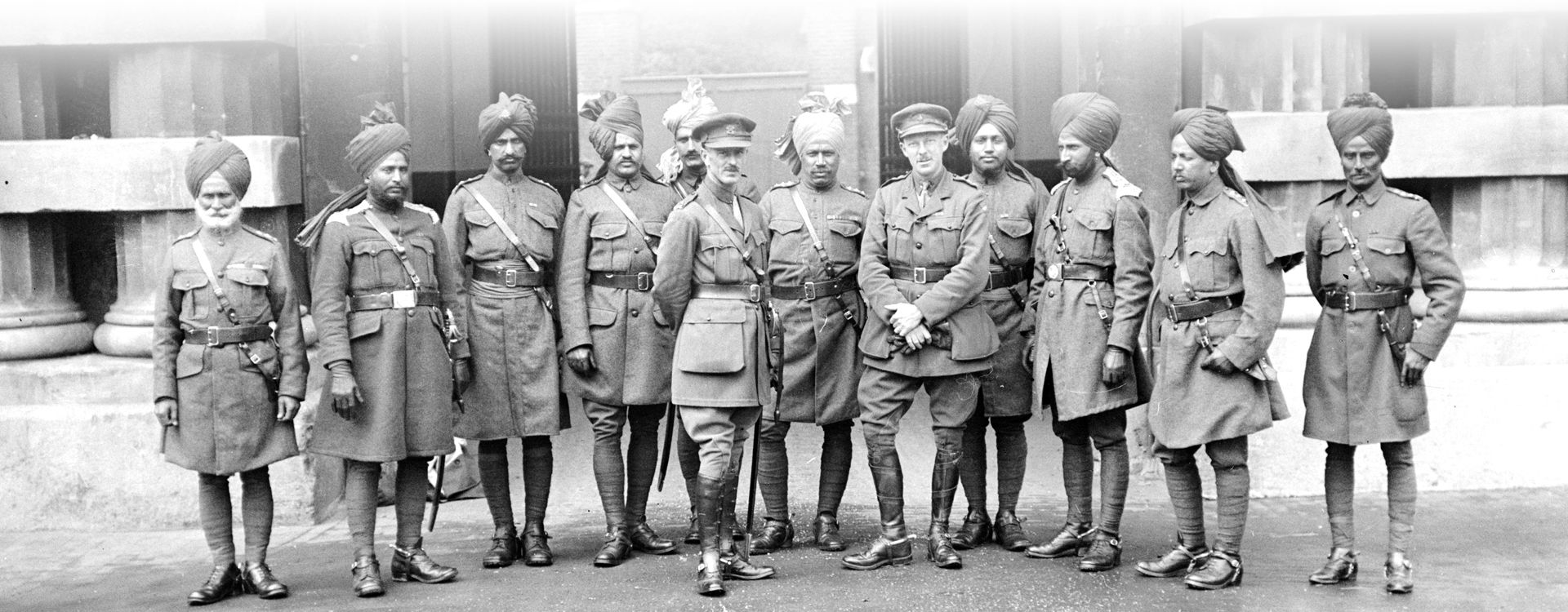
In 1914 India had the largest voluntary army in the world, though a question mark hangs over the word ‘voluntary.’ Military service, with a monthly salary of Rs 11, was a source of livelihood. Financial incentive, fused and confused with family and community traditions, ideas of izzat (honour), the promise of a plot of land and varying levels of coercion by the colonial government, led many to enlist. They were further encouraged by nationalist leaders such as Mahatma Gandhi, who thought that India’s war service would be rewarded with a ‘Dominion’ status. A contemporary poster — showing an empty military uniform, a rifle and a handful of coins (Figure 2) — sums up the attractions, as does the following recruitment song:
Here you get old shoes, there you’ll get full boots, get enlisted…
Here you get torn rags, there you’ll get suits, get enlisted…
Here you get dry bread, there you’ll get biscuits, get enlisted…
Here you’ll have to struggle, there you’ll get salutes, get enlisted.3
Once in the trenches, many sepoys wrote back home despairingly: “For God’s sake don’t come, don’t come, don’t come to this war in Europe.”4 Meanwhile, the womenfolk wove their desolation into songs: “My husband and his two brothers/All have gone to laam [l’arm]/Hearing the news of war/Leaves of trees got burnt.”5
Between 1914 and 1918, hundreds of thousands of Indians voyaged across the kala pani (black waters) to the heart of whiteness and beyond — from the tsetse-fly-infested bushes of East Africa to the rugged foothills of Gallipoli to the arid tracts of Mesopotamia. They got an early bitter taste of combat at the badly directed Battle of Tanga in East Africa in November 1914 but soon developed new bush warfare tactics and helped to capture Kilimanjaro Hill in 1916 with British and South African units. In Gallipoli, they acquired new trench warfare skills as they fought alongside Australian and New Zealand forces. Indian troops also served in East and West Persia, Palestine, Egypt, Salonika, Aden, Tsingtao and Trans-Caspia. Mesopotamia was, however, its main area: some 588,717 Indians, including 295,565 combatants and 293,152 non-combatants (often forming porter and labour corps), served there.6 After a long, terrible siege at Kut-al-Amara (August 1915–April 1916) during which many Indians starved — some sepoys famously refusing to eat horsemeat — General Charles Townsend finally surrendered; Kut fell on April 29, 1916. Around 10,000 Indians from the 6th Division were captured and treated brutally by the Turks. The letters of Captain Dr. Kalyan Mukherjee and the memoir Abhi Le Baghdad (1957) by the medical orderly Sisir Prasad Sarbadhikari, both taken as prisoners of war, evoke the Mesopotamia campaign with extraordinary power.
The most visible and documented Indian troops were, however, the 140,000 who served in Europe. In late September and early October 1914 the first Indian units arrived at Marseilles, totalling around 24,000 men. Comprising two infantry divisions (Lahore and Meerut) and a cavalry brigade, they formed the Indian Expeditionary Force A (IEFA) and gallantly held around 12 miles or one-third of the British line from October 23 to the end of the First Battle of Ypres. In the course of the next year, they took part in some of the major offensives — the Battle of Neuve Chapelle (March 10–12), where the Indians formed half of the fighting force, as well as in Aubers Ridge (May 9), Festubert (May 15–25) and Loos (September 25–mid-October). From October 1915, the Lahore and Meerut divisions were ordered to leave for Egypt and Mesopotamia, while the Cavalry Corps stayed on until 1918. While the shock of industrial firepower might have initially overwhelmed the Indian troops, resulting in a high number of ‘hand-wounds,’ allegedly self-inflicted, in late 1914, recent scholars have shown how the Indian Corps on the Western Front became more tactical, battle-hardy and resilient in 1915.7 There are accounts of spectacular bravery: of the nine Victoria Crosses given to Indians, eight were awarded to those serving on the Western Front.
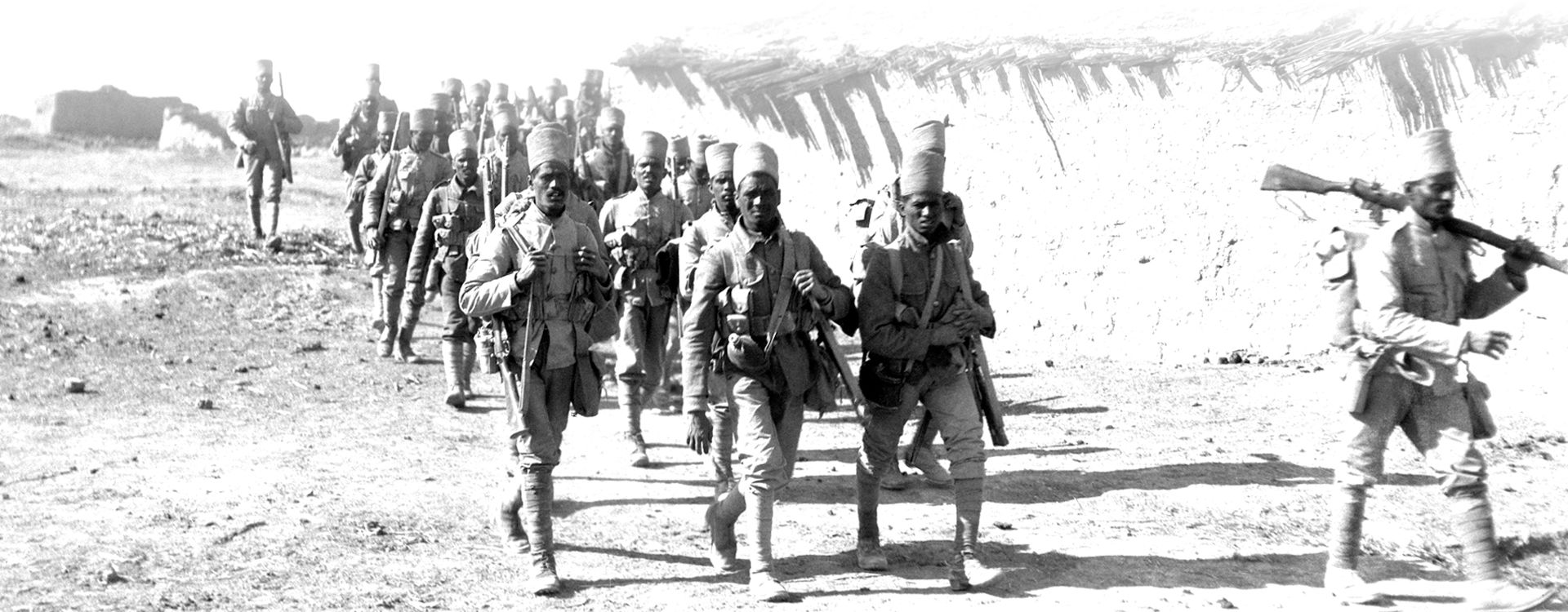
Yet, to excavate the sepoy experience on the Western Front, one needs to go beyond such medals and memorials to the letters they wrote or, more often, dictated to scribes. The originals are lost, but the censored and translated extracts give rare insight into the sepoy heart, from their initial wonder at the ‘modernity’ of France (“The country is very fine, well-watered and fertile… Each house is a sample of Paradise”), to thrilling accounts of romance and sexual braggadocio (“The ladies are very nice and bestow their favours upon us freely”), to the trauma of the trenches:
The condition of affairs in the war is like leaves falling off a tree, and no empty space remains on the ground. So it is here: the earth is full of dead men and not a vacant spot is left…
Cannons, machine guns, rifles and bombs are going day and night, just like the rains in the month of Sawan. Those who have escaped so far are like the few grains left uncooked in a pot.…
As tired bullocks and bull buffaloes lie down in the month of Bhadon so lies the weary world. Our hearts are breaking.8
These letters are in many ways the Indian literature of the trenches: these men may have been non-literate but being non-literate does not mean being non-literary. One can hear in them the rich oral tradition of Punjab, full of colour, feeling and imagery, which the novelist Mulk Raj Anand mines in Across the Black Waters (1939), the only novel in English on the Indian war experience.
Meanwhile, at the back of the front, a whole new world of cultural encounters — from fleeting glimpses of people at towns, fields and markets to more sustained relationships — was opening up. Some formed deep bonds with their ‘French mothers,’ with whom they billeted. Consider the following letter:
The house in which I was billeted was the house of a well-to-do man, but the only occupant was the lady of advanced years. Her three sons had gone to the war. One had been killed, another had been wounded and was in hospital, and the third was at time in the trenches.… During the whole three months, she ministered to me to such an extent that I cannot adequately describe her (kindness). Of her own free will she washed my clothes, arranged my bed, polished my boots for three months.… When we had to leave that village this old lady wept on my shoulder.9
Affection, maternity, bereavement and loneliness are delicately blended. It is not in the world of casual sex and romance, but in these affective dyads between the young sepoys and the elderly, bereaved French women that some of the most fruitful Indo-European encounters took place. No wonder, an Indian sepoy wrote: “after we are gone we shall mostly remember France very kindly.”10
Professor Santanu Das of All Souls College, Oxford
- ↩
Mall Singh, Voice-recording, Humboldt University Sound Archive, PK 619. Translated from Punjabi by Arshdeep Singh Brar. Also see Santanu Das, India, Empire and First World War Culture: Writings, Images and Songs (Cambridge, 2018).
- ↩
Statistics of the Military Effort of the British Empire during the Great War 1914-1918 (London, 1920), 777
- ↩
Jat Gazette, November 1914.
- ↩
Havildar Abdul Rahman, 9th Rifles, France, Censor of Indian Mails (CIM) 1914-1918, British Library, London, IOR, L/MIL/5/825/4.
- ↩
See Amarjit Chandan, http://apnaorg.com/articles/amarjit/wwi.
- ↩
India’s Contribution to the Great War (Calcutta, 1923), 97.
- ↩
See George Morton-Jack, The Indian Army on the Western Front (Cambridge, 2014).
- ↩
CIM, British Library: L/MIL/5/825/2, 245; L/MIL/5/825/3, 394; L/MIL/5/825/5, 758.
- ↩
Letter of Sher Bahadur Khan, France, 9 January 1916, CIM, L/MIL/5/828/112.
- ↩
January 1916, British Library, IOR MSS EUR F143/89.