Portugal and the First World War
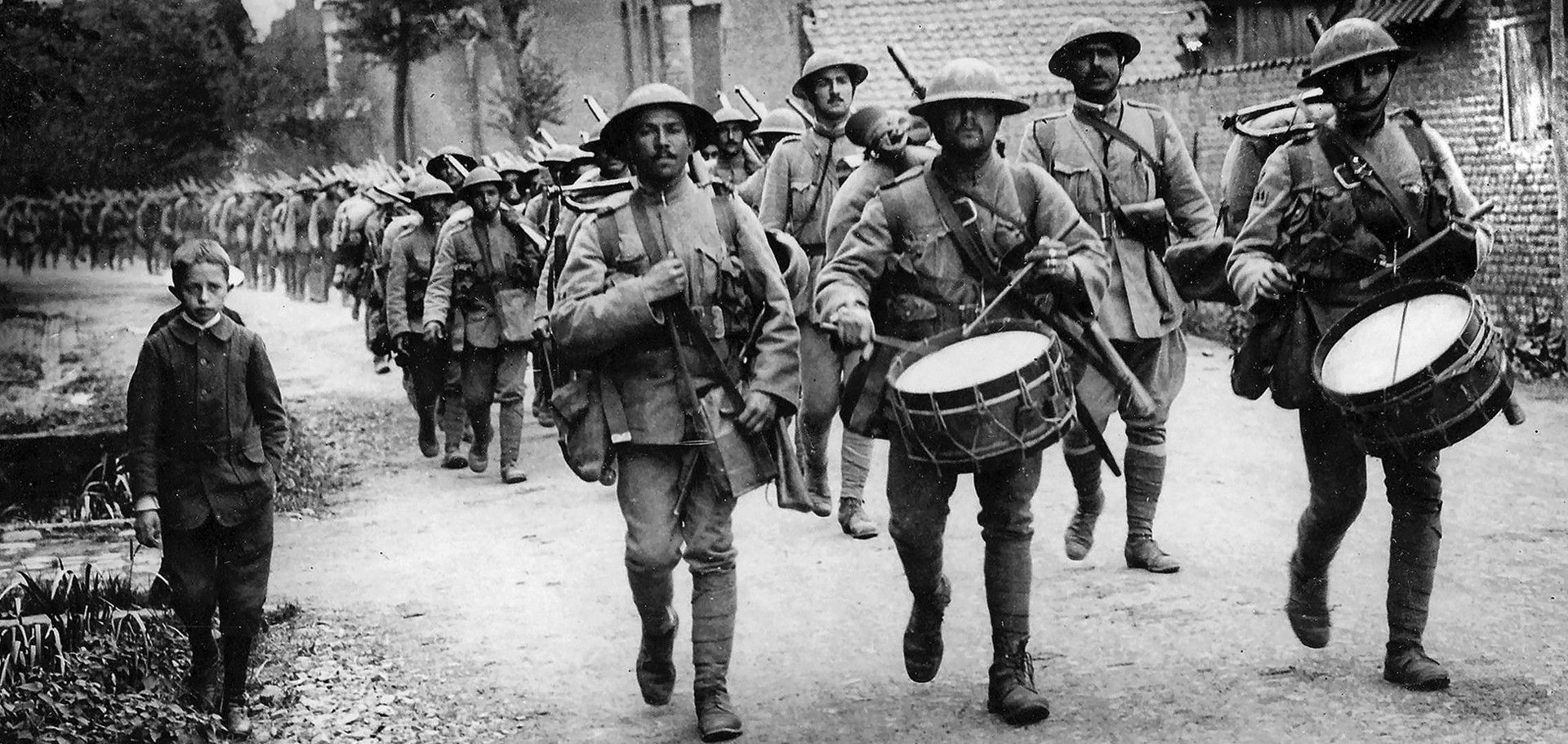
The First World War, known in Portugal as the Great War, was a milestone in modern Portuguese, European and world history. This conflict caused profound changes in the fields of politics, economics, society and culture both during and after the conflict.
The Austro-Hungarian Empire’s declaration of war on Serbia on July 28, 1914, led to the mobilisation of the European alliances that existed at the time, and soon brought most of the European continent into the conflict while also affecting dominions, colonies and territories around the world.
Portugal’s participation in the First World War was not immediate, a condition that can be analysed in different ways. The Portuguese government, influenced by its alliance with Great Britain (the oldest diplomatic alliance in the world), was persuaded by Britain to abstain publicly from declaring neutrality in the conflict, an official position that left the country in an ambiguous position — neither neutral nor belligerent.
Fighting in Africa
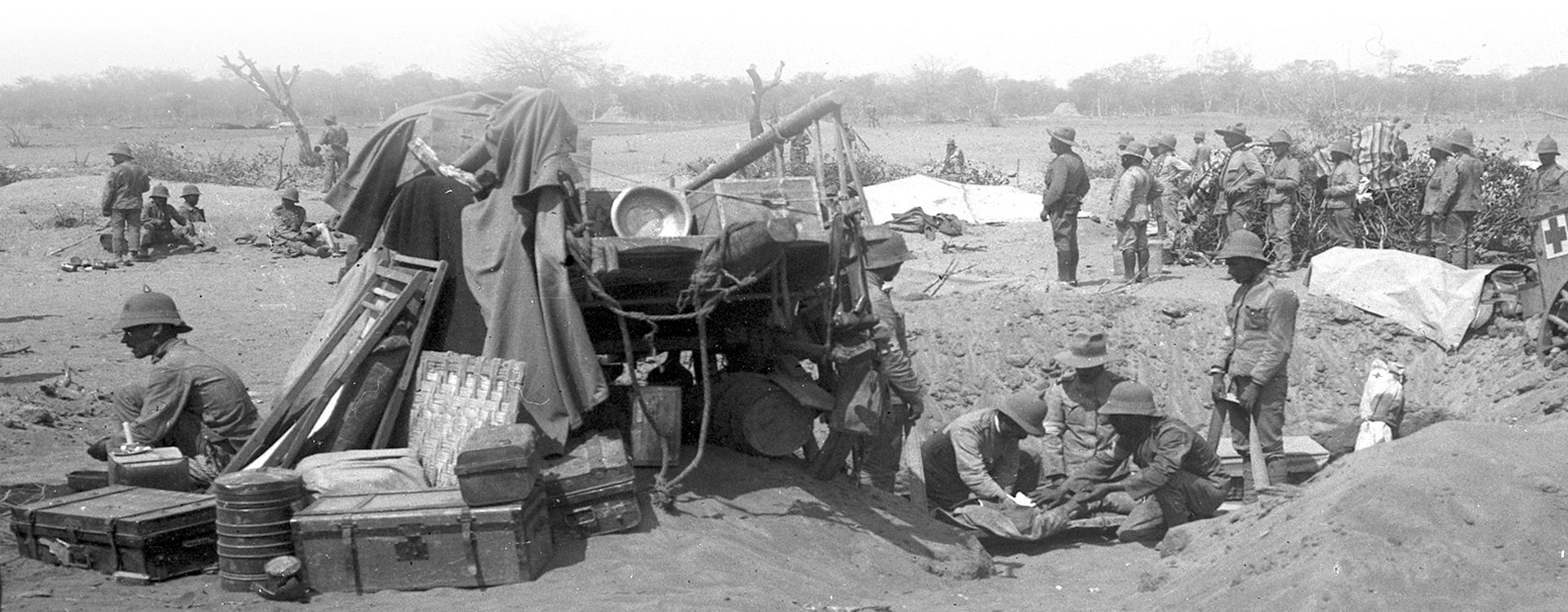
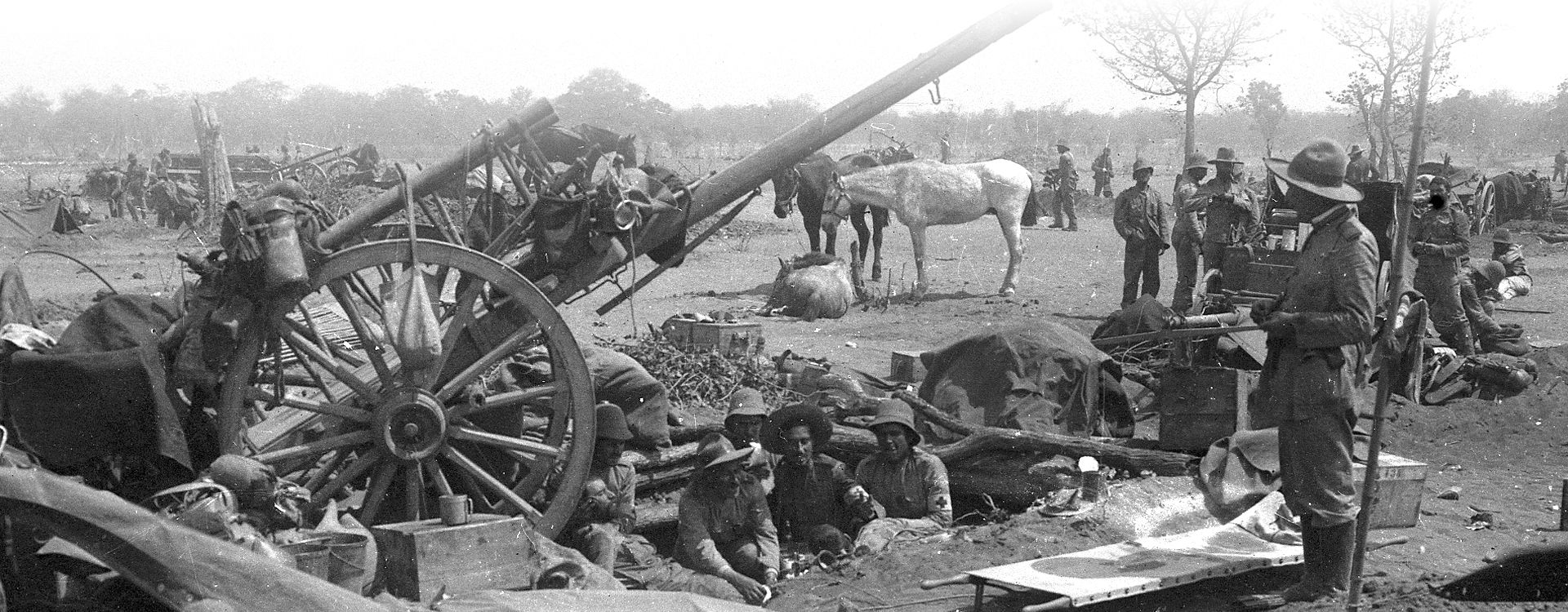
Despite Portugal’s initial neutral stance, the outbreak of the war exposed the country’s need to defend its national sovereignty in its African colonial territories such as Angola and Mozambique, which bordered the German colonies in South East Africa (Namibia) and in East Africa (Tanganyika).
On August 25, 1914 on Mozambique’s northern border, the Germans attacked the Portuguese post of Maziúa, on the Ruvuma River, marking the beginning of German hostilities against Portugal in Africa. In response, the Portuguese government, without declaring war, decided to reinforce its defences in Angola and Mozambique. The first military expeditions were sent to Africa on September 11, commanded by Lieutenant Colonel José Augusto Alves Roçadas (1865-1926) in Angola and Colonel Pedro Massano de Amorim (1862-1929) in Mozambique. These forces arrived in Angola at the end of September and in Mozambique at the beginning of October.
In southern Angola, small clashes between Portuguese and German soldiers were escalating. On October 19 three Germans were killed at a border post. The German response was immediate, attacking the Cuangar Fort on October 31, killing twenty-one Portuguese. On December 18, the Battle of Naulila began with a strong German attack, causing the deaths of sixty-nine Portuguese and the withdrawal of Portuguese military forces.
Engagement on the European Front
In 1916 Portugal’s position in the war changed completely. On February 17, 1916 the British government asked the Portuguese to seize all German ships berthed in Portuguese ports and six days later Portugal published a decree with those instructions.
In response to the seizure of their ships, on March 9 Germany officially declared war on Portugal. The entry of Portugal’s military into the European war then began to take shape. The young republican regime had only come to power in 1910 after the collapse of the Portuguese monarchy, and it was determined to fight alongside Great Britain and the Allied forces.
With the declaration of war, Portugal intensified its mobilisation and military training, ordering that all men between the ages of twenty and forty-five not yet registered for military service should do so immediately.
The Establishment of the Corpo Expedicionário Português (CEP)
Creating the Corpo Expedicionário Português (the Portuguese Expeditionary Corps) was one of the most remarkable events in modern Portuguese military history. Despite limitations and tremendous difficulties, between April and July 1916 what became known as the Miracle of Tancos took place. The new force was under the command of War Minister General José Norton de Matos (1867-1955), and later of General Fernando Tamagnini de Abreu (1856-1924).
This ‘miracle’ was the description given at the time for the accelerated training and instruction of around 20,000 men at a large improvised camp near the River Tagus. This training centre became known as the ‘City of Paulona,‘ owing to the hundreds of camp tents with their wooden poles (pau) and their canvas coverings (lona). The main aim of the Miracle of Tancos was to demonstrate the potential of Portugal’s military, thereby convincing the British and French to accept the CEP as a fighting unit on the Western Front.
On January 3, 1917 Portugal and Great Britain signed an agreement on the conditions of Portuguese participation in the conflict, stipulating that CEP forces would be sent to France. The CEP included two divisions of three brigades each, which were supported by artillery, engineering and medical units. It was determined that the CEP would be under the command of the First Army of the British Expeditionary Force.
At the end of January 1917 Portuguese soldiers started to board transports to sail to France. Their destination was the sector in Flanders between the La Bassée Canal and the River Lys. The military units were placed in concentration areas to the rear of the British sector. There, the next phase of their military instruction began, after which followed an internship in the trenches to acclimatize them to the difficult and deadly conditions. Within six months, more than 50,000 Portuguese soldiers had arrived on the Western Front.
Fighting in the Trenches in 1917 and 1918
The first CEP troops had gone into the trenches in early April 1917 and a few days later, on April 4, the first Portuguese soldier on the European front was killed: António Gonçalves Curado of the 28th Infantry Regiment (Figueira da Foz).
Operating in extremely harsh conditions and under constant bombardment and attacks, the first months of trench warfare were very difficult for the Portuguese. The wear and tear experienced by Portuguese brigades — owing to long periods in the trenches, logistical problems, the harshness of the following winter and a lack of reinforcements — led to a high level of demoralisation and a lack of discipline among the soldiers.
The CEP’s circumstances were so difficult that British Command ordered the Portuguese units to be replaced. But this decision did not come soon enough to avoid the most significant episode in Portugal’s participation in the First World War.
The replacement order was received on April 8, 1918, but in the early hours of the morning of April 9, the Germans launched an offensive that began the Battle of La Lys (Fourth Battle of Ypres) or, as the Germans referred to it, Operation Georgette. General Erich Ludendorff (1865-1937) was in charge of planning the German attack and General Ferdinand Von Quast (1850-1934) executed it. Starting with an intense bombardment between La Bassée and Armentières, the 6th German Army attacked several British divisions and the 2nd Portuguese division between the La Bassée Canal and the River Lys.
The Battle of La Lys lasted until the end of April and decimated the Portuguese forces. While there are conflicting sources, it is thought that around 1,300 were killed, 4,600 were wounded and 2,000 were missing. Furthermore, more than 7,000 Portuguese soldiers were taken prisoner by German troops.
The Armistice of November 11, 1918
On November 11, 1918 the Armistice of Compiègne was signed between the Allied nations and Germany, bringing about the temporary cessation of hostilities. Despite the disaster of the Battle of La Lys, by the war’s end Portugal had secured its African colonies of Angola and Mozambique and the Republican government remained committed to the Allied nations. So, it was imperative to continue in the same path as the victors of the war.
After the Treaty of Versailles was signed in 1919, Portugal marched alongside its allies in the Victory Parade in Paris on July 14, in London on July 19 and in Brussels on July 22.
Portugal’s participation in the First World War was notable because of the lack of a strong, pre-existing military infrastructure in addition to insufficient logistical support and an industrial and technical base capable of supporting the needs of its expeditionary forces in Africa and the CEP in Europe. This resulted in a logistical, technical, industrial and even financial dependence on Portugal’s British ally until the end of the war.
Between 1914 and 1918 a total of 105,000 Portuguese soldiers were mobilised for the fronts in Africa and Europe. More than 11,000 lost their lives (a number that includes African troops from Portugal’s colonial forces), 16,000 were wounded and almost 11,000 were made prisoners of war. These losses are the ultimate expression of Portugal’s participation in this devastating conflict.
In remembrance of these soldiers, especially those who lost their lives, Portugal consecrated April 9 as the day to celebrate the strength and bravery of the Portuguese soldier.
This date — officially known as Combatant’s Day but formerly known as Race Effort Day — is celebrated at a formal ceremony in the Monastery of Batalha, where the Tomb of the Portuguese Unknown Soldier has stood since 1921. Interestingly, this Tomb contains the bodies of two soldiers: one from Mozambique and one from France. The monumental ensemble to the memory of the Portuguese soldier is composed of the Tomb, the Flame of the Homeland Lamp and the Christ of the Trenches — a religious representation of a mutilated Christ from France’s Neuve-Chapelle region that had endured the German bombardments during the war and was transferred to Portugal in 1958.
Remembrance Day, or Armistice Day, is also commemorated every year in Portugal on November 11. Remembrance ceremonies are organised at First World War monuments across the country and, in particular, a military ceremony is held in the city of Lisbon.
Bibliografia/Bibliography
Andrade, A. M. (Coord.). (2018). O Exército Português na Grande Guerra (1914-1918). Estado-Maior do Exército.
Arrifes, M. F. (2004). A Primeira Grande Guerra na África portuguesa: Angola e Moçambique (1914-1918). Edições Cosmos, Instituto da Defesa Nacional.
Lousada, A. P., & Rocha, J. S. (Coords.). (2018). Portugal na 1.ª Guerra Mundial: uma história militar concisa. Comissão Portuguesa de História Militar.
Martins, L. J. M., & Ribeiro, F. C. de O. (Coords.). (2017). I guerra mundial: das trincheiras ao regresso. Instituto Universitário Militar.
Santos, J. M. A. (2015). A guerra não se fez só com balas! Uma outra faceta da participação portuguesa na Grande Guerra. Exército Português.
Telo, A. J., & Sousa, P. M. (2016). O CEP: os militares sacrificados pela má política. Fronteira do Caos.
Telo, A. J., & Pires, N. l. (2018). A Grande Guerra em África: os que inovam, os que se adaptam e os outros. Fronteira do Caos.
Telo, A. J., & Regalado, J. F. (2021). Portugal e o fim da Grande Guerra: o renascer da Fénix. Fronteira do Caos.