Slovenia and the First World War
In 1917 Ivan Cankar, one of the most outstanding Slovenian writers, referred to the period of the First World War as the years of horror, a time that brought moral depravity, many deaths and unspeakable suffering, but perhaps also hope and redemption. He might have anticipated that the events triggered by the war would put an end to the old world, and that the war’s end would reinforce the need to rethink the values that would determine the future of the world.
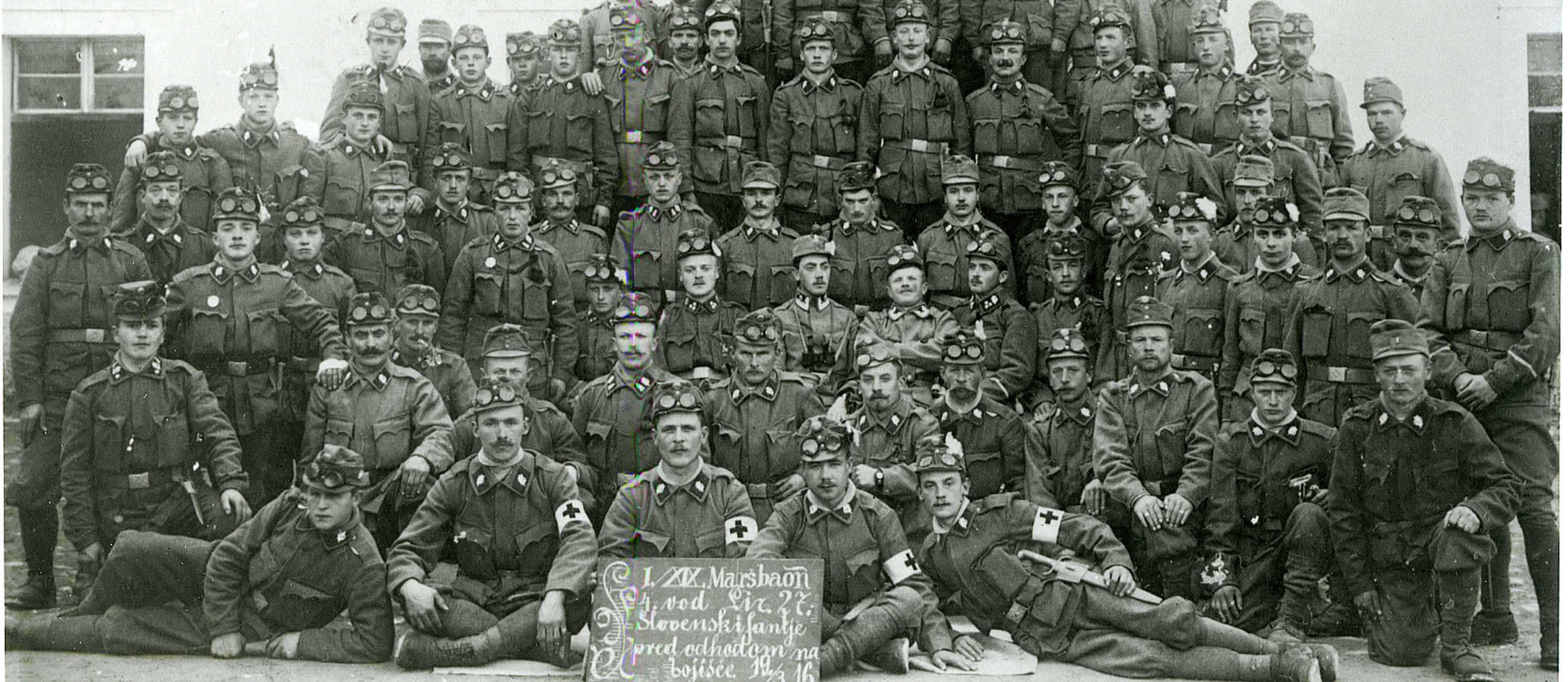
For the Slovenes and for the history of Slovene ethnic territory, the First World War was a significant turning point in behaviour and sentiment. It was an enormous cultural event, not merely a military one. It caused changes in the political map of Europe, in national relations, in horizons of science and technology and in the individual and collective comprehension of world events. The Slovenes took part in the different stages of the world encounter: they were soldiers, captives, deserters, prisoners of war, rebels, internees, refugees, the occupiers and the occupied. Above all, they fought on one of the most sanguinary battlefields of Europe — the Soča (in Italian, Isonzo) — on Slovene ethnic territory.
The Slovene’s military engagement was numerically far smaller than that of the great European powers, but all the more devastating for the Slovenian national community. It was outstanding in terms of military experience. The Slovenes and other inhabitants of Slovenian provinces served (mostly) in the Austro-Hungarian Army. Meanwhile, the Venetian Slovenes, citizens of the Kingdom of Italy, were mobilised into the Italian Army, which also brought them to the Isonzo battlefield.
Slovenian soldiers fought on the Eastern (Russian), Balkan and Italian fronts. They were also part of the Austro-Hungarian contingent in the German Army, which brought them to many other battlefields.
At the beginning of the war, 3,350,000 Austro-Hungarian soldiers were called to active service. Two million were sent to the battlefields, and some estimates indicate that 30,000 Slovenes were part of the contingent. During the whole period of the war, some 160,000 Slovenian soldiers were in combat in the Austro-Hungarian theatres of war. Out of 1.2 million fallen Austro-Hungarian soldiers, between 36,000 and 40,000 Slovenes lost their lives and 11,467 became war invalids. One-fifth of Slovenian families faced long-term consequences of the war: 31,039 war widows had to maintain 49,182 family members incapable of earning a livelihood.
On May 23, 1915 the Italian government, having withdrawn from the Triple Alliance, declared war on Austria-Hungary. Italy had signed the so-called London Pact on April 26, 1915, which promised it many of the Austro-Hungarian territories, including South Tyrol, Trentino, Trieste, Gorizia and Gradisca, the Tarvisio basin, part of (Slovenian) Carniola, Istria to Kvarner, the Croatian islands of Cres and Lošinj with neighbouring islands, northern Dalmatia with its islands, the islands of Sasena and Valona, the Dodecanese archipelago near the coast of Asia Minor and an appropriate share of potential territorial gains in Asia Minor and Africa.
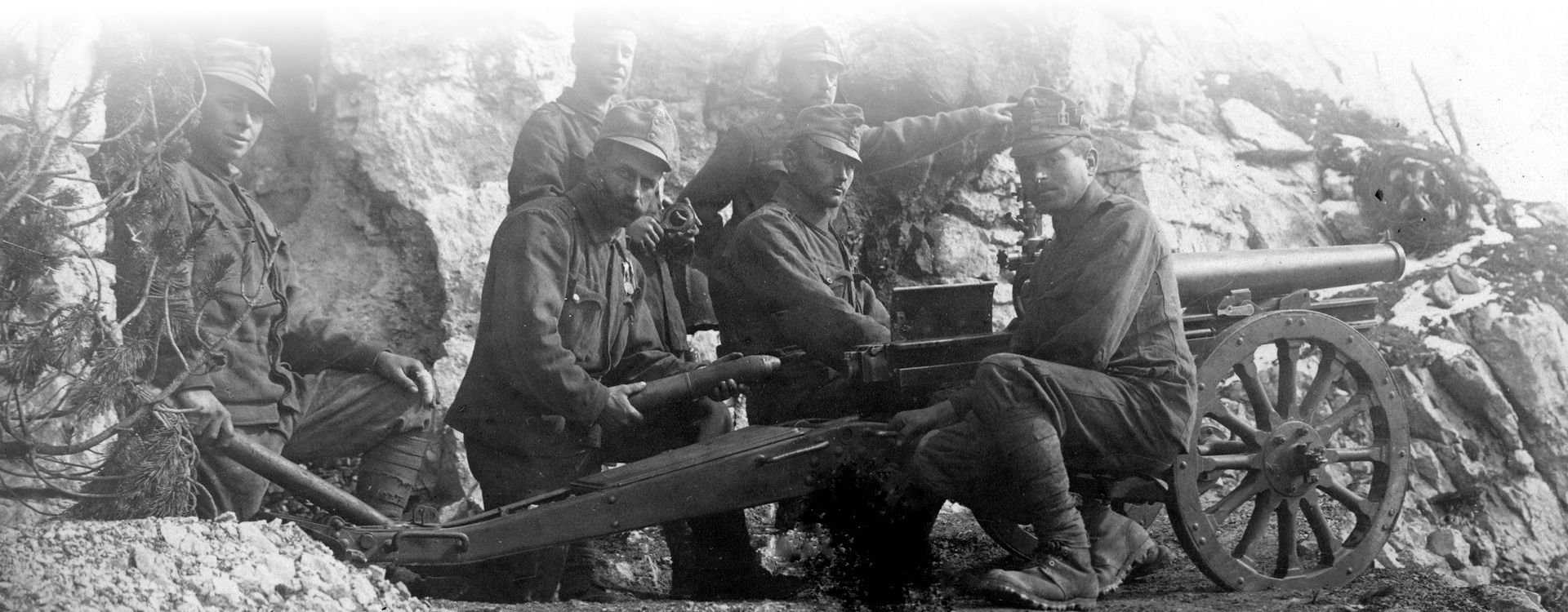
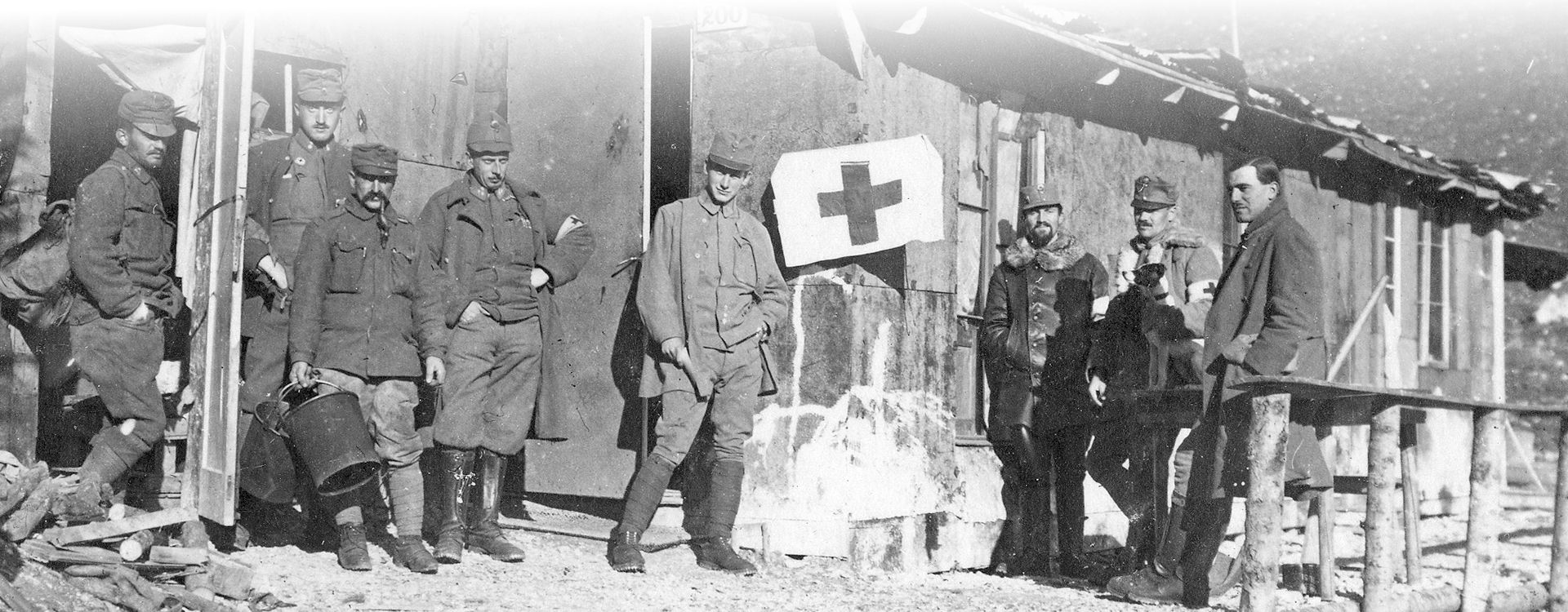
The South Western or Italian-Austrian Front was 600 kilometres long, stretching from the Stelvio Pass on the Swiss-Italian-Austrian border, through Tyrol, Carnia, the Soča basin and down to the Adriatic Sea. Ninety kilometres of the southern branch of the front, the Isonzo Front, cut into Slovenian ethnic territory. The Isonzo Front was the stage of twelve offensives, eleven of which were unleashed by the Italian Army. The last one, carried out in October 1917 by joint Austrian and German forces, was a breakthrough. It was referred to as the Battle of Caporetto (Kobarid), after which the front ‘withdrew’ from the Slovenian territory. The battles on the Isonzo Front caused around 1.5 million casualties, 187,000 to 300,000 of whom were fallen soldiers. According to some estimates, the Isonzo battlefields took the lives of 2,000 to 3,000 Slovenian soldiers. The rest of the Slovenian territory turned to the hinterland area of the front, with many military hospitals and military personnel dominating the everyday life of the civilian population.
The beginning of hostilities on the Isonzo Front unleashed a widespread migration of the Slovenian civilian population. They retreated from the advancing Italian Army to the so-called redeemed provinces (terre redente) and from the ethnic territories that did not belong to Italy but were nevertheless regarded as its crucial strategic and security asset. The Austrian government evacuated the Slovenian population (approximately 80,000) from the left flank of the front to inner Slovenian lands, as well as to refugee camps in Lower Austria, while 10,000 to 12,000 Slovenes were transported to the Kingdom of Italy. The war in the Isonzo area left in its wake indescribable devastation, a sheer ecological and economic disaster.
On November 3, 1918 the Italian Army returned to the Slovenian (former Austro-Hungarian) territory and seized it in compliance with the stipulations of the London Pact, pushing the border farther eastward. In the summer of 1919, the military administration gave way to the civil one. And finally, when the Treaty of Rapallo concerning the border between the Kingdom of Italy and the Kingdom of Serbs, Croats and Slovenes was signed on November 12, 1920, these territories were ultimately annexed to the Kingdom of Italy.
The Memory of the War
In the past ninety-five years, Slovenian remembrance of the First World War has oscillated between triumph and oblivion. The disintegration of the Habsburg Empire and the formation of the state of the Kingdom of Serbs, Croats and Slovenes caused the oscillation of the Slovenian war memory between forgetting and triumph. Officially, the story ranged from nearly denying the war experience of the majority of Slovenian men in the defeated and disintegrated Austro-Hungarian Army and celebrating the triumphant rhetoric of the Serbian — more often emphasised as Yugoslav — volunteer war experience characterised by limited participation and minor importance in Slovenian military history.
In the post-war loss of one-third of their national territories, the rapid downfall of the Hapsburg Empire and the creation of the Kingdom of Serbs, Croats and Slovenes, the Slovenian provinces fundamentally changed their historical perspective. The Austrian idealistic concept of history was replaced with the ethnocentric Yugoslav concept of history and remembering.
In the first Yugoslavia that existed until 1945, remembrance of the past, including the First World War, was very difficult since the war became both a unifying and separating element. It drew a strong distinction between the victors/liberators/unifiers (i.e. Serbs, Montenegrins, volunteers) and the vanquished/liberated/united (i.e. Slovenes, Croats and Serbs from the former Habsburg monarchy). It was impossible to celebrate both victory and defeat at the same time.
This had a decisive impact on the positioning of the Slovenian war experience when it came to the state-building memory of the war as it was to be fostered in the Kingdom of Serbs, Croats and Slovenes. Based on the Yugoslav identity achieved during the Great War, it emphasised the past of volunteers and the unification of the Southern Slavs.
The only public bearers of the interwar Slovenian memory were Slovenian war veterans. Their objective was to garner public support and acknowledgement for the efforts made by Slovenians during the war. They tried to persuade Serbian and Montenegrin veterans, whose war had been crowned by victory, that the Slovenian experience of war should not be neglected. But until the end of the first Yugoslavia in 1945, there were at least two parallel narratives on the First World War: the Yugoslav one and the former Austro-Hungarian one.
The principal activity of Slovenian war veterans was concentrated around the economic issues of the veterans, war invalids and widows, as well as being dedicated to the memory of their fallen comrades. This resulted in more than 160 memorials and plaques being erected all over Slovenian territory. But the veterans were unable to secure a central Slovenian monument to the Unknown Soldier, promoted by the Slovenian political authorities.
Another of the neglected themes of the Slovenian war experience was the memory of the Isonzo Front. The post-war situation in that region, occupied and later annexed to Italy, laid a heavy burden over the remembrance of the war on Isonzo. Due to Italian oppression, no public memory was permitted, while on the other hand the Italian government raised up monumental ossuaries along the whole former front, three of them along the Isonzo River: in Kobarid (now in Slovenia), Oslavje (near Gorizia/Gorica with a dense Slovenian population) and Redipuglia.
The end of the Second World War and the creation of socialist Yugoslavia altered the Slovenian as well as the Yugoslav narrative of the First World War events. The social revolution had brought new perspective; social-revolutionary elements were introduced into the historical narrative practices. The First World War, together with the Isonzo Front, became a second-class historical topic because it did not fit into either the concept of supranational martyrdom of the partisan liberation movement during the Second World War or into the concept of brotherhood and unity in the post–Second World War socialist Yugoslavia.
Only after the 1980s did an awakened public and historiographical interest in the First World War produce many war memoirs, exhibitions, private museums and systematic modern historical research. The central theme of the historical remembrance became the Isonzo Front. The turning points in Slovenian historiography on the war were marked by establishing the first museum of the First World War in Kobarid in 1990, the writing of the first PhD in the history of the First World War in 1998 and the first interdisciplinary Slovenian conference in 2004: “The Great War and the Slovenes.” Slovenian history of the First World War was then set in the European context, using terminology deemed to best determine the multidimensionality of wartime, and war experience, which were transposed into a cultural-historical perspective.
The decades-long Slovenian oblivion of the First World War came to an end simultaneously with democratic changes and Slovenian state independence, but that could be a mere coincidence.
Petra Svoljšak, Research Centre of the Slovenian Academy of Sciences and Arts