The Ottoman Empire and the First World War
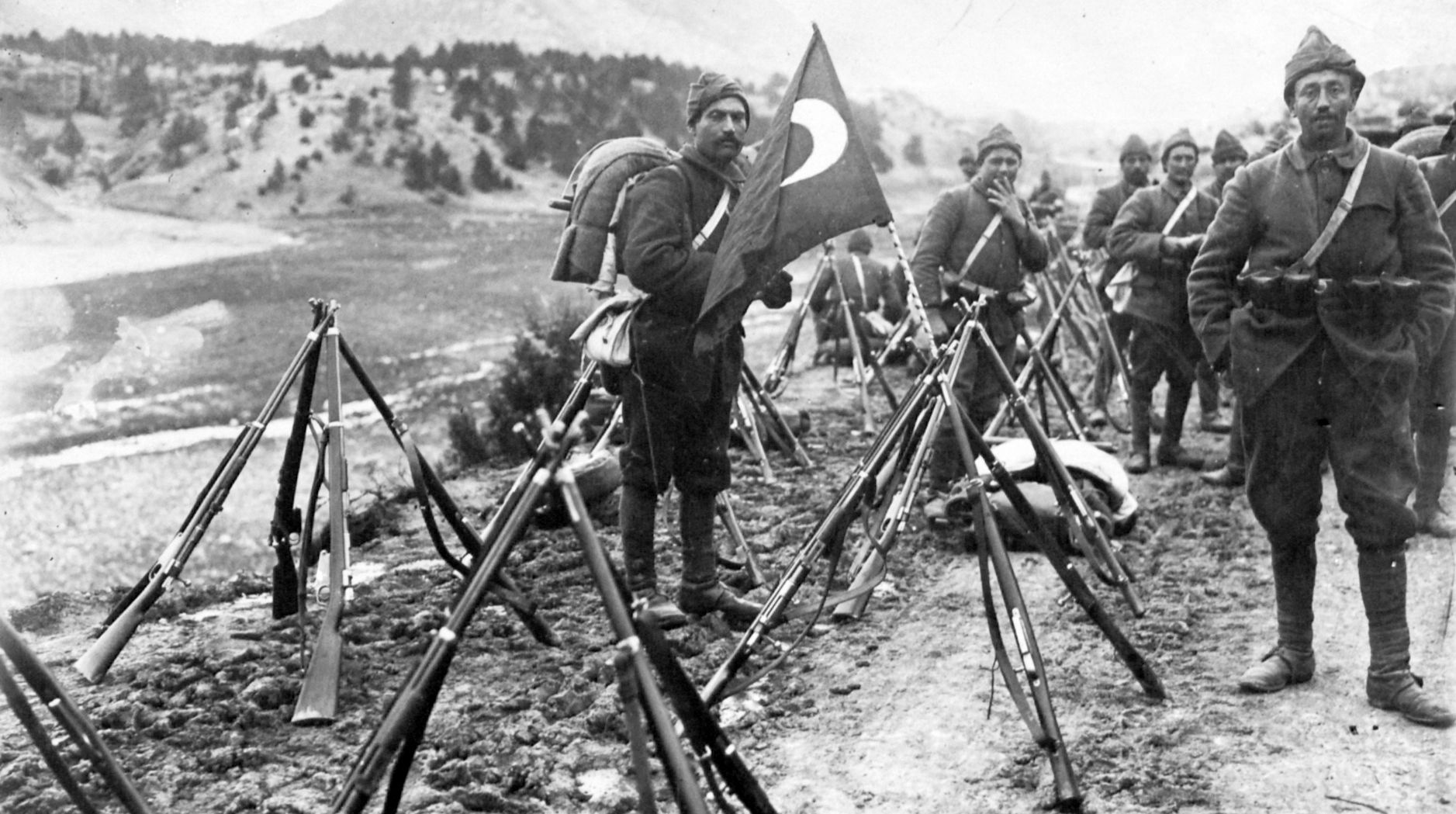
The Ottoman Empire was one of the major belligerent powers during the Great War, the salient event of the past century which ushered in modern times. The Empire entered the war on October 29, 1914 and surrendered almost exactly four years later on October 30, 1918.
The Conflict’s Origins For The Ottomans
The Ottoman Empire considered that the First World War had been forced upon it. In 1907 the Empire faced a strategic impasse when Britain formed an alliance with Russia. Britain’s interest in collaborating with Russia – which had designs on the occupation of the Empire’s capital of İstanbul – was to secure warm-water ports for its navy in the Black Sea. This strategy made Britain the Ottomans’ adversary.
A half century earlier, the British had tried to deny the Russians Istanbul and had fought in the Crimean War against Russia and alongside the Ottoman Empire to do so. But to counter Germany’s growing power, in the early twentieth century Britain reshaped its foreign policy which resulted in the great powers’ rivalry taking a different form. Even though in 1904 Britain and France had formed an alliance (the Entente), Britain’s army was still small and Russia’s military strength was seen as necessary to contain Germany. The British-French alliance was intended to first encircle the “new potential threat” of Germany, and then to contain it. The realignment of powers meant that Britain was making alliances with former adversaries; first with France in 1904 and then Russia in 1907.
A condition of Britain’s alliance with Russia was that İstanbul be promised to the Russian Tsar as the glavni priz (the great prize) for first engaging the Ottoman Empire in war and then potentially helping to dismantle it. Should the Ottoman Empire collapse, Britain also had an interest in acquiring Palestine and what was called the Fertile Crescent (lands that included parts of present day Iraq, Jordon, Lebanon, Israel and Syria). So, there were numerous reasons to engage the Sublime Porte – as the Ottoman government was referred to – in a war that could add territory to the British Empire.
The Ottoman Empire had existed as a stable power for five centuries. It was a well established Muslim state under a Sultan and Caliph. The Empire incorporated a diverse range of ethnic and linguistic groups through its sensitively built and nurtured Millet (nations) system that for hundreds of years had provided significant legal freedoms for its many diverse groups. The Millet system resulted in freedom of worship and non-territorial autonomy for these groups and had protected Jews in the Ottoman Empire from religious persecution and ill-treatment, unlike the percecution of Jews in many parts of Europe in previous centuries. The Millet system accomodated religious and cultural diversity and successfully blended non-Muslim elements into the Empire’s social and economic fabric.
However, it was still possible to describe this system as the rule of Muslims over Christians, a label which the political adversaries of Sublime Porte had often found useful. When dealing with issues of domestic security and public safety, the Ottoman Empire could face atrocity propaganda that often was used to help justify the intervention of other parties. In contrast to the Ottoman Empire’s acceptance of non-Muslims, there had been ethnic cleansing of Muslims during the Libyan and Balkan wars of 1911-1913 – conflicts which had also resulted in loss of territory for the Empire.
The Ottoman’s Attempts to Join the Entente
In September 1908, the Ottoman government requested Britain’s help in modernizing and reorganizing the Empire’s navy, as well as reinforcing the defences of the Dardanelles Straits that led to the Black Sea. In October of that year, two British admirals were assigned to the Ottoman navy to work on the various aspects of naval modernization
However in early August 1914, the newly built battleships Sultan Osman and Reshadiye, purchased and paid for by the Ottomans from Vickers and Armstrong in Britain, were confiscated by the British just as five hundred Turkish sailors arrived by steamer at Newcastle on Tyne to sail the ships home. No promise of compensation was made. When Britain entered the war, it was revealed that another first class battleship as well as torpedo boats, destroyers, twin screw submarines and a floating dock were still under construction for the Ottomans in Britain. The sudden decision to deny the Ottomans the battleships Sultan Osman and Reshadiye therefore came at a highly sensitive time. The Sublime Porte had believed they were in an alliance with Britain. This British action drove the Ottoman government to seek a defensive alliance with Germany, and on August 2, 1914 such an alliance was made but kept secret because the Sublime Porte did not want to prompt any reaction on the part of the Entente.
The Ottoman’s defensive agreement with Germany stipulated that the Ottoman Empire would observe strict neutrality with regard to the conflict between Austria-Hungary and Serbia. The focus of the Empire’s alliance with Germany was Russia, stating that should Russia intervene with military measures and bring about a casus foederis for Germany with relation to Austria-Hungary, then this casus foederis would also exist for the Ottomans against Russia. In no part of the agreement were there measures or acts directed against Britain or France. Basically, the Sublime Porte wanted a guarantee for their territorial integrity against the ambitions of the Entente nations. However, the partition of Ottoman lands remained one of the Entente’s objectives. Specifically, the British government in London turned down the Ottoman’s proposals for alliance, while offering no acknowledgement of the Empire’s desire to remain neutral and stay out of the war.
Having become evident that the Entente nations desired to partition the Empire, the Ottomans had little choice other than to enter the conflict. Any further path to neutrality by the Sublime Porte was impossible due to the need for financing, for munitions and for allies in order to defend their Empire against hostile states determined to carve up its lands.
In addition, there were tensions concerning the new Berlin-Baghdad Railway, which Britain had refused a stake in. The proposed railway would connect Berlin to Baghdad and was intended to proceed south to the Persian Gulf. Some saw the railway as enhancing regional trade beyond Britain’s control, but for others it had military implications that favoured Germany. Britain had built railways in many parts of the world but had never approved of other nations doing so, especially when those rail lines led to sea ports. Another war related complication of the Berlin-Baghdad Railway involved Serbia. The Entente wished to exclude Serbia from the railway’s route lest the Serbs acquire a gateway to Europe.
The Empire Enters the War
It became increasingly evident that Istanbul had been promised to Tsarist Russia as a war prize. Weeks before the Ottoman Empire declared war on October 29, 1914, Britain had blockaded Basra and the Dardanelles. Earlier in August, the Russian Tsar had ordered the Governor General of the Caucasus to prepare for inciting revolt and insurrection in the adjacent Turkish provinces, including the arming of the rebels there.
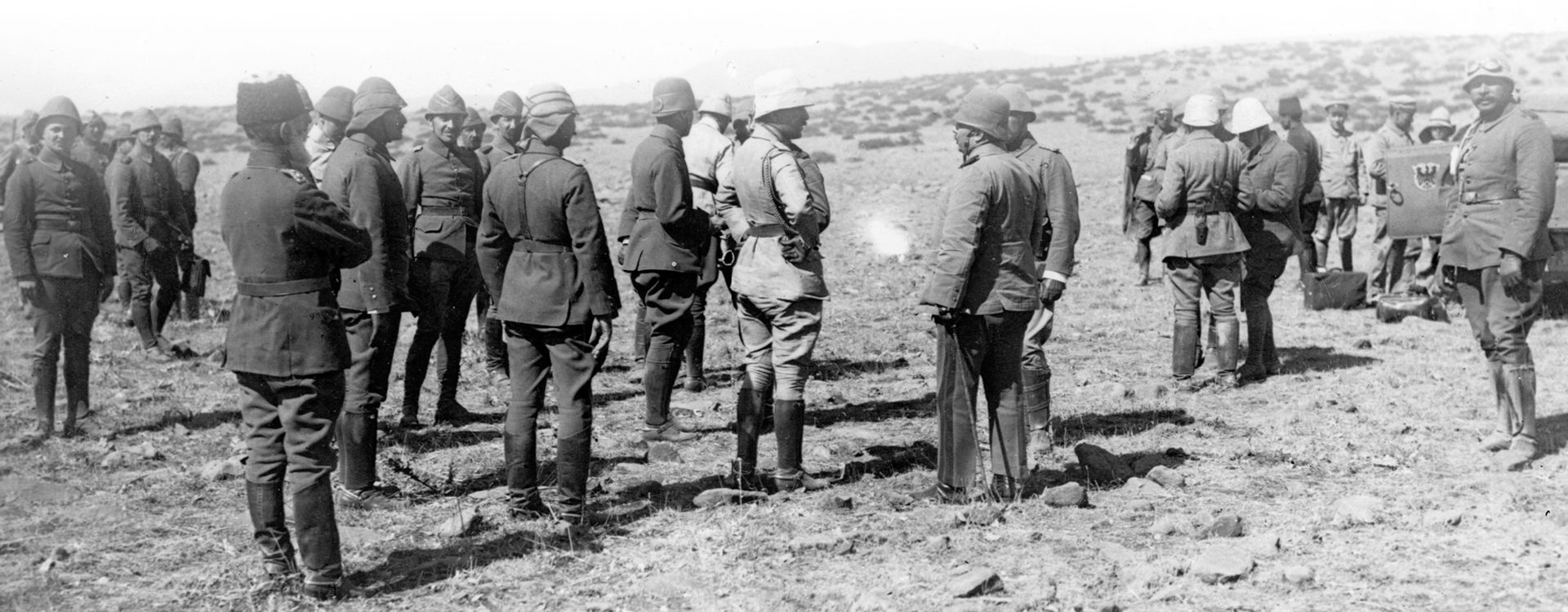
At the war’s outbreak in August 1914, when elements of Britain’s Mediterranean fleet attempted to intercept the German battlecruiser SMS Goeben and the light cruiser SMS Breslau, the German vessels evaded the British and passed through the Dardanelles. On reaching İstanbul, they were handed over to the Ottoman Empire and renamed Yavuz Sultan Selim and Midilli. German Admiral Souchon took command of the Ottoman navy and took direct command of Yavuz Sultan Selim and Midilli. These ships joined the Ottoman’s Black Sea fleet and on October 29, 1914 bombarded Russia’s Black Sea ports of Sebastopol, Odessa, Novorosski and Kefe. Prior to this, Russia’s constant naval patrolling along the Ottoman’s Black Sea coasts, as well as mine laying operations near the Turkish Straits had escalated tensions. By this time there were approximately 4,000 German officers, sailors, and soldiers stationed onshore and on Ottoman warships. And with the Black Sea controlled by the renamed SMS Goeben and SMS Breslau , the Ottoman navy was essentially under German control. Thus, the bombardment of Russian ports by Ottoman naval ships was orchestrated by those who directly sought conflict with Russia in which the Ottoman Empire would be directly implicated. The result was Russia’s declaration of war against the Ottomans. The Empire formally entered the First World War on October 29, 1914.
The Empire’s Theatres of War
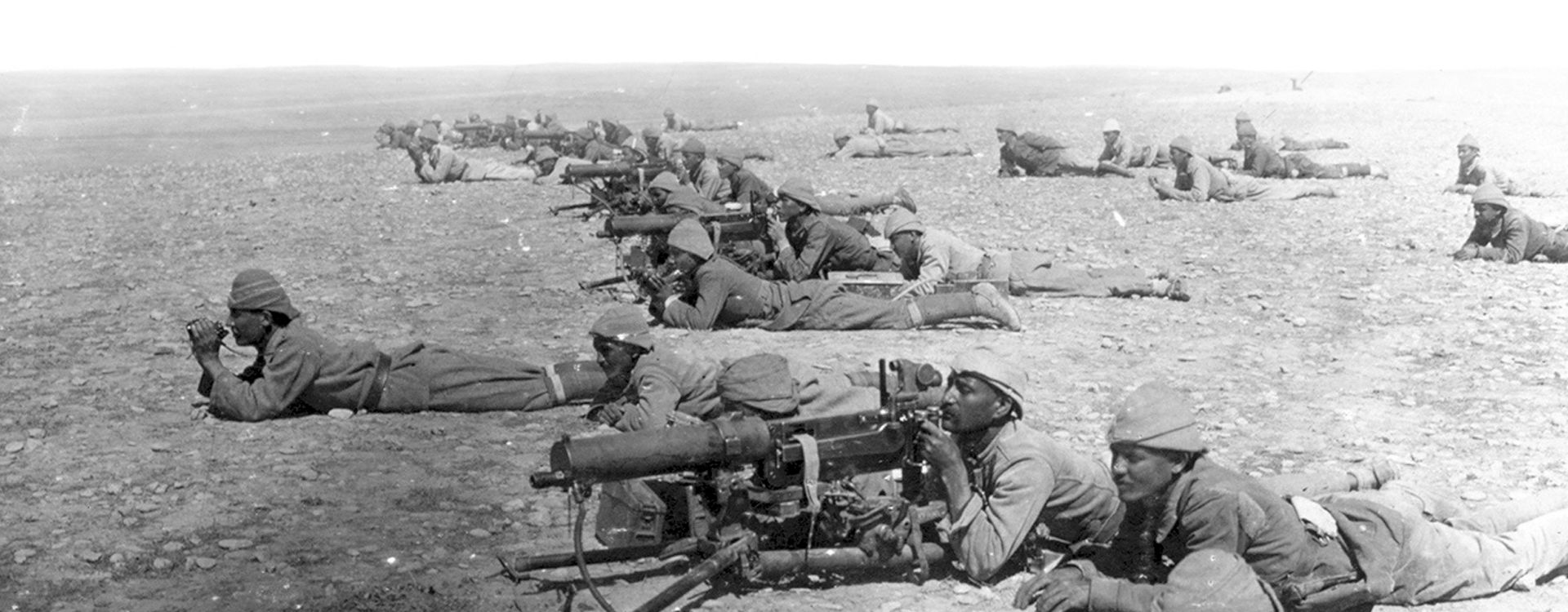
From 1914 to 1918, the Ottoman army fought on major fronts in Europe, Galicia, Gallipoli, the Caucasus and in Palestine, Suez (the Canal Campaigns) and Hejaz-Yemen. It was also active on smaller fronts, both combined with Central Powers’ forces as well as independently which required significant military commitments. These fronts were in Persia, Azerbaijan, Romania, Galicia and Macedonia. The Empire was neither industrialized nor had abundant resources yet its performance during the Great War was resilient and effective, which surprised both allies and foes.
1915 was a particularly challenging year for the Ottoman Empire as it became engulfed in a life or death struggle. At Gallipoli in the west, it faced one of the great amphibious operations of history, while at the same time on the eastern front it was attacked by Russian forces. Britain had decided to force its way through the Dardanelle Straits, beginning with a naval operation and followed by landings on the beaches at Gallipoli. The fighting at Gallipoli lasted more than eight months and ended in failure for the Allies, which affected their plans to extend the war to other parts of the Ottoman Empire, namely to the Syria-Palestine and Hejaz-Yemen fronts.
That said, in 1915 the British had also been moving up through Arabian peninsula, inciting revolts and blockading the coasts. The Russians had invaded through the Ottoman Empire’s eastern provinces, advancing in conjunction with the local insurrection of the Empire’s non-Muslim elements. In April 1915 the Treaty of London was signed (and kept secret) between the Entente and Italy, which was followed in January 1916 by the Sykes-Picot Treaty. These treaties, on the presumption that the Empire would be defeated, divided the Ottoman’s territory among Britain, France, Russia and Italy.
After the Allied defeat at Gallipoli, there was concern in Britain about negative ramifications in the Muslim world. To regain the upperhand, especially in India and other Muslim colonies, British decision makers planned new offensives in the Near East. The next great battle between the Ottomans and the British took place in Kut-al-Amara, south of Baghdad. Following the Ottoman’s success at Gallipoli, they were able to transfer two experienced army divisions to the near eastern theatre, thereby shifting the military balance in their favor. When the British failed to break through Ottoman positions at Selmanpak near Baghdad, they withdrew to Kut al-Amara. The Ottoman’s long siege of the British positions at Kut al-Amara, lasting from December 3, 1915 to April 29, 1916, was successful and resulted in the surrender of approximately 13,300 Allied soldiers, of whom more than seven thousand were from the British-Indian Army.
Following the Allied losses at Gallipoli and Kut al-Amara, the British government feared an increase in pan-Islamic sentiment and the risk of revolts both in the Arab world and India. London resorted to directing insurgencies in the Arab Peninsula against the Ottomans and turned to bringing Greece into the Entente. However, Greece’s King Constantine I and his government had intended to remain neutral but Britain was determined to have as many neutral nations as possible join the conflict on their side. On June 1, 1916 King Constantine I was deposed by Greek factions that favoured the Entente, forcing the monarch to leave the country. The Entente had offered Greece territory in Anatolia if they joined the alliance, which Greece did on June 15, 1917.
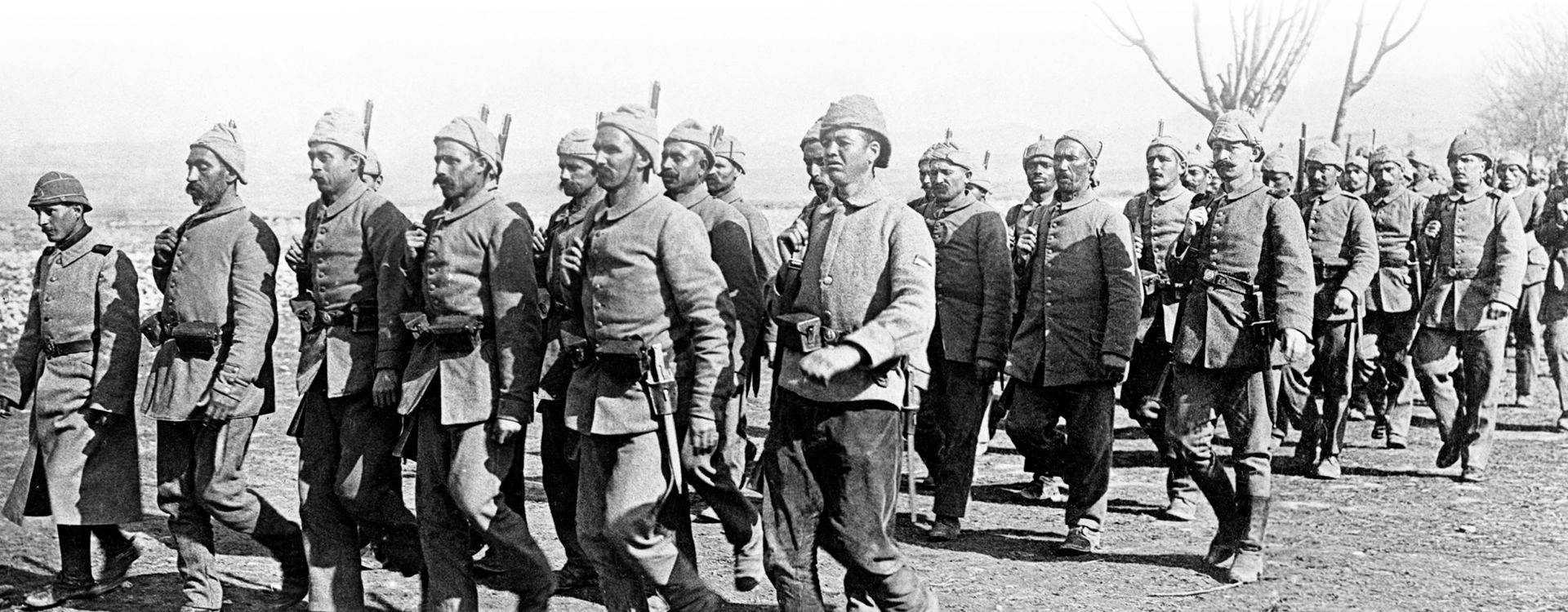
The collapse of Tsarist Russia in 1917 following the Bolshevik revolution provided some relief to the Ottoman Empire. The Bolsheviks had repudiated all Tsarist undertakings and İstanbul was no longer considered as Russia’s glavni priz. However, the Ottoman’s armistice with the British on October 30, 1918, which the Empire had to accept, was soon followed by the invasion of their lands; first Istanbul in early November, then soon after that Ottoman provinces in Iraq, and seven months later Greek forces occupied the Empire’s second biggest city, Izmir.
The Ottoman Empire Accepts The Mudros Armistice
By November 13, 1918, an Allied armada had anchored in the Bosphorus Strait, even though the Sublime Porte had signed the Mudros Armistice which had imposed severe conditions on the Ottomans. The Empire became the only member of the Central Powers to have its capital city occupied within days of signing the armistice. Also while under occupation, the Ottoman territories through the Treaty of Sèvres (August 10, 1920) were divided among the victors, leaving the Turks with only a small area of land in the Anatolian interior. All these actions honed the Turkish determination to mount a resistance and to save their motherland.
Turkish National War of Liberation and the Birth of the Republic of Türkiye
From 1920, İstanbul turned from being an Allied “war prize” to a centre for war planning. The Greek army was continuing its advance into Anatolia, while the Entente’s occupation of the Empire under the Sykes-Picot Treaty was faltering as the forces of newly established Turkish National Assembly, led by Mustafa Kemal, were advancing.
Following the November 11, 1918 armistice between the Entente and the Central Powers, the Great War continued by proxy for more than four years between Greece and the former Ottoman Empire – years that proved costly in human lives. Only the signing of the Lausanne Peace Treaty on July 24, 1923, brought a final end to the hostilities. Through another prism of analysis, it could be said that with regard to the Ottoman Empire, the Great War neither commenced in 1914 nor ended in 1918. Rather it began in June 1911 with Italy’s assault on Libya and the subsequent Balkan wars, and did not end until the Lausanne Peace Treaty was signed in 1923. The Treaty’s preamble opens with “The British Empire, France, Italy, Japan, Greece, Roumania and the Serb-Croat-Slovene State of the one part, and Turkey of the other part; Being united in the desire to bring a final close to the state of war which has existed in the East since 1914”.
Following the ending of the extended war, it was only through the work of visionary statesmen that the damages could finally be settled and friendship achieved between the last remaining belligerent First World War nations, namely Türkiye and Greece. The Great War brought calamity to the peoples who lived in the fold of the Ottomans, robbing the Empire of many of its best and brightest. In the Gallipoli campaign alone, the Ottoman Empire’s casualties included nearly 30,000 high school and university graduates.
The Republic of Türkiye was proclaimed on October 29, 1923, three months after the signing of the Lausanne Treaty. The formation of the Republic was a success and brought the nation to grips with modernity. A forward-looking industrious country emerged, reminiscent of the phoenix which rose from its own ashes.
The arbitrariness that engulfed the post First World War order continues to affect the lives of present generations in manifold ways. In a broad sense, the Great War was part of a series of great events which shaped the flow of history and helped to define Türkiye’s place in today’s democratic grouping of nations, as well as in the NATO Alliance. Türkiye’s European vocation and its status as a negotiating country for membership are testimonies to that.
Dr. Y. Turan Çetiner