Hungary and the First World War
On June 28, 1914 Gavrilo Princip assassinated Archduke Francis Ferdinand, heir to the Austro-Hungarian throne. The fact that the crime was aided by Serbian state officials made it possible for the Austro-Hungarian Monarchy to settle a long-drawn-out conflict by military means. On July 23, Austria-Hungary demanded from Serbia not only the punishment of those participating in the assassination but also the cessation of all activities against the Monarchy. Serbia refused to let Austro-Hungarian police participate in the official investigation of the assassination, which resulted in the breaking-off of diplomatic relations between the two states. On the same day, both the Serbs and the Austro-Hungarians mobilised their armies. On July 28, one month after the assassination, Vienna declared war on Serbia.
The Austro-Hungarian armed forces deployed against Serbia attempted two campaigns to break the resistance of the considerably weaker Serbian Army, which was, in fact, stubbornly defending itself. Their first attempt in August ended in complete failure; moreover, the following month their spirited rival advanced into Hungary. The incursion was pushed back, and in the autumn Austria-Hungary carried out a second attempt that, though hard fought, made slow and constant progress. The retreating Serbs were forced to evacuate Belgrade, which was captured by Austro-Hungarian troops on December 2. However, a Serbian counterattack broke the power of the Monarchy’s exhausted troops, and by the middle of December all the occupied areas had to be evacuated.
On mobilising in July 1914, four armies of the Monarchy were tasked with holding up the superior Russian troops. This was in an offensive meant to take advantage of the slower mobilisation of the opposing army. But after early successes by the end of August, the Russians gradually proved their superiority, resulting in the repulse of Austro-Hungarian troops behind the Carpathians.
1915
In 1915 the conflict’s centre of gravity in Europe shifted to the Eastern Front. In Galicia, the Austro-Hungarian troops, confined to the line of the Carpathians, were fighting against the Russian ‘steamroller.’ They were able to stop it and for a long time tried in vain to roll it back. However, their breakthrough at Gorlice in early May produced a glimmer of hope of forcing Russia to sign a separate peace. This significant victory by the Central Powers was achieved by German and Austro-Hungarian troops under the command of German General August von Mackensen. In the sector stretching from Gorlice to Tarnów, an attack was launched on May 2, 1915 that resulted in the capturing of Russian positions 15 to 20 kilometres deep by May 4. By the end of August the front line had moved 450 kilometres to the east.
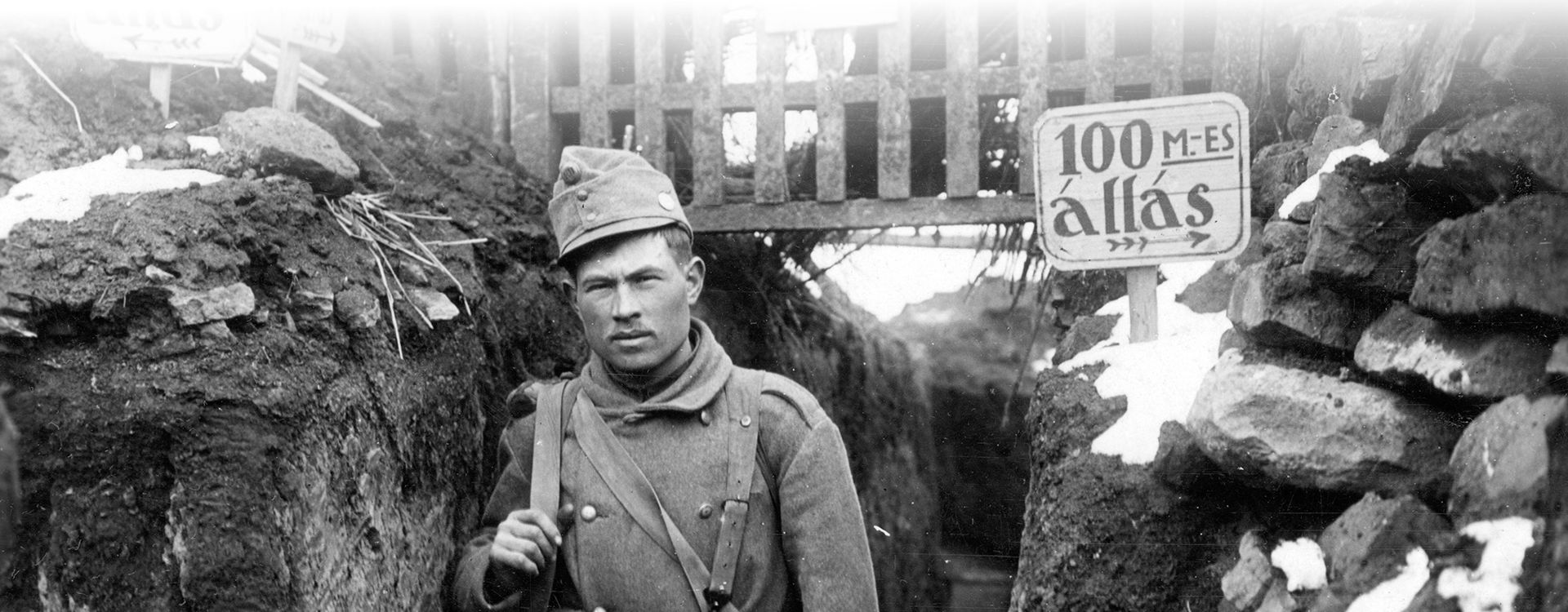
Despite these victories for the Austro-Hungarian Monarchy, the war became a struggle on three fronts when former ally Italy declared war on May 23. As the Southeastern Front stagnated, the bloodiest battles took place in the section along the Isonzo River. In the first four Battles of the Isonzo, the Italians launched most of their attacks on the Doberdò Plateau, situated in the southern part of the front line, as well as on the bridgeheads of Görz and Tolmin on the right bank of the river. The Austro-Hungarian troops annihilated all of Italy’s breakthrough attempts, and from December 1915 the front stalemated into costly trench warfare. From the beginning, the fighting that inflicted heavy casualties was fought by predominantly Hungarian troops on the Doberdò front line. Also, from the day Italy declared war, the Austro-Hungarian Navy did its bit of fighting on the Adriatic Sea.
In the autumn of 1915 the Central Powers, having joined forces with Bulgaria, managed to defeat Serbia. On October 5 they started an offensive in the Balkans. Belgrade fell rapidly, and Serbian troops, threatened on three sides, retreated while strongly defending themselves. The Serbian Army became almost completely encircled at Kosovo Polje, but 150,000 men escaped and reached the Adriatic Sea. Entente ships transported them from Albanian ports to Corfu and later to Saloniki.
1916
In the east in 1916 the Russian breakthrough at Lutsk–Okna (the Brusilov Offensive) temporarily brought the Austro-Hungarian Monarchy to the verge of collapse, which was only avoided with substantial German help. However, this intervention came at a great price. The military independence of the Monarchy on the Russian Front practically ceased to exist. From this point onward, it was German military leadership that defined the conditions and directions of their joint warfare.
At the end of August former ally Romania joined forces with the Entente in return for the promise of territorial gains. The Romanian invasion of Transylvania created a grave situation. Only with German help could the greatly superior but cautiously advancing Romanian troops be repulsed from the country.
The combination of the Romanian attack and the halting of the Brusilov Offensive removed a large number of troops and materials from the Italian Front. Still, in the second half of 1916 none of the four Italian offensives against the dug-in Austro-Hungarian forces (the 6th, 7th, 8th and 9th Battles of the Isonzo) achieved the expected decisive breakthrough. The bridgehead at Görz, however, was captured by Italians in August, and the Austro-Hungarian supreme command was forced to evacuate the Doberdò Plateau that had become undefendable.
1917
This year was mostly marked with successes by the Central Powers. In February the Russian Revolution broke out, and although the offensive by the Russian provisional government (the Kerensky Offensive) struck a heavy blow on Austro-Hungarian troops, Russian successes did not prove long-lasting. The Central Powers launched a counterattack on July 19 and recaptured Galicia and Bukovina from Russian forces. On November 7, 1917 the Bolshevik government came to power through the Russian Revolution and declared a ceasefire with the Central Powers on December 5.
The war against Romania was also successful, and by the beginning of January 1917 German and Austro-Hungarian troops had occupied the country. Only with Russian help had Romanians been able to stabilise the front line along the Danube and Seret Rivers. In July, as part of the Kerensky Offensive, the Romanian forces (reorganised with the assistance of the Entente) attacked the Austro-Hungarians and eventually with Russian cooperation halted the Central Powers’ counterattack in August 1917. After the truce with the Soviet–Russian government, Romania, unable to continue the battle alone against the German and Austro-Hungarian troops, secured a ceasefire with the Central Powers at Focşani in December.
On the Italian Front, the 10th and 11th Battles of the Isonzo resulted in the capture by the Italians of the Bainsizza Plateau between Görz and Tolmin. The Austro-Hungarian supreme command knew that their defence would not endure another attack so they asked for German help. The operation launched on October 24 (the 12th Battle of the Isonzo, or the Caporetto Breakthrough) and was the largest offensive the Central Powers made on the Italian Front. German and Austro-Hungarian troops broke through the Italian front line over a span of 32 kilometres. The Italian defence collapsed, their troops were withdrawn first behind the Tagliamento River and then the Piave, where the Italian front line was strengthened with British and French reinforcements. The German and Austro-Hungarian troops advanced to the Piave by November 10, taking 300,000 prisoners while persuing the enemy and capturing a considerable amount of munitions.
1918
After the truce was signed in December 1917, the Central Powers and representatives of the Soviet–Russian government signed the Brest-Litovsk Peace Treaty on March 3, 1918; as a consequence, in May Romania was forced to make peace. Most of the fighting then ceased on the Eastern Front. At the same time, on the other fronts the struggle of the Central Powers against the Entente had become doomed to failure. In the Balkans, Entente troops launched a successful offensive, which resulted in the collapse of the Bulgarian Front. Bulgaria signed a ceasefire with the Entente on September 29, 1918 and stepped out of the war.
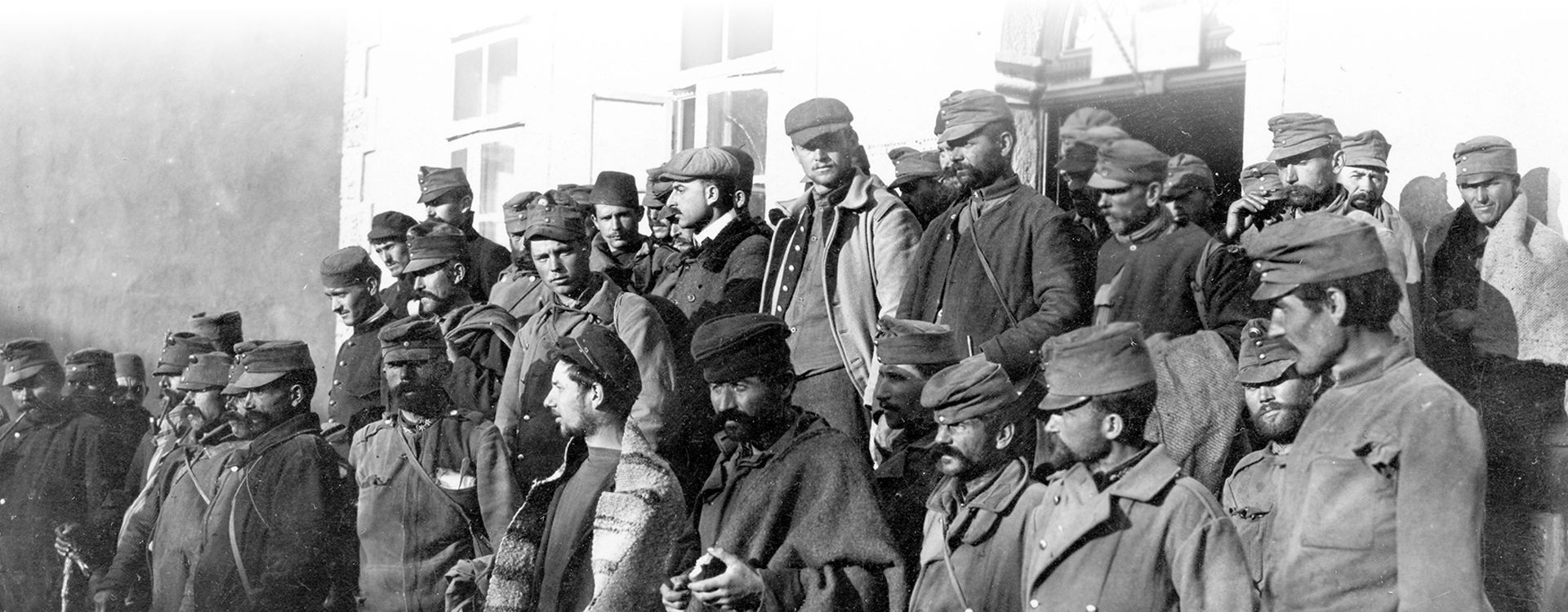
From a strategic point of view, the fate of the Austro-Hungarian Monarchy was determined in the Southwestern Front. During the Italian attack launched on October 24 from the Piave, Italian troops reinforced with British, French and American units drove a wedge into the Austro-Hungarian defences over a width of 40 kilometres. The Austro-Hungarian supreme command asked for a ceasefire. On November 3, near Padua, in the name of a practically non-existing Austro-Hungarian Monarchy, Viktor Weber, the General of the infantry, signed the armistice that put an end to Austro-Hungary’s Great War. The armistice ordered the unconditional and total capitulation of the Austro-Hungarian armed forces, instructed which areas were to be evacuated and obliged the Monarchy to release all prisoners-of-war and to discharge and render up its Navy.
By the end of October 1918, the Monarchy had dissolved into successor states. On October 30 and 31 the ‘Aster Revolution’ took place in Budapest, and Minister of War Colonel Béla Linder ordered a partial discharge of the army on November 8. Thus, Hungarian troops (all of which had been in foreign territories when the armistice was signed) did not have the chance to fight for the defence of their homeland upon returning from the front. The Belgrade Convention, signed on November 13, laid down the borders of occupation of Hungary, and limited the size of the Hungarian forces to six infantry and two cavalry divisions.
The Consequences
During the First World War, 9 million men and 100,000 women in the Austro-Hungarian Monarchy put on uniforms. From the territory of Hungary, 3.4 million men were enlisted for military service and another 800,000 men were employed in war factories and mines, or were mobilised as reserves. Altogether, 4.2 million Hungarians were activated for military purposes. One million Austro-Hungarian soldiers were killed in action, more than half a million went missing, 1.9 million were wounded and 1.7 million were taken prisoner. Among the belligerents, the Monarchy’s losses stand in fourth place.
The losses of Greater Hungary (660,000 deaths and over 800,000 prisoners) were notably larger in relation to Hungary’s population than with the losses of the Empire’s Austrian counterpart, since many more were mobilised from the agrarian areas than from the more industrial western part of the Empire, where people worked in the munitions industry. Moreover, the vast majority of the Hungarian peasantry was enlisted to serve in the infantry, which suffered the greatest losses. Additionally, the inhabitants of the occupied regions of Galicia and Bukovina could not be enlisted for military service for a large part of the war.
As a result of the Trianon Peace Treaty signed on June 4, 1920, Hungary also suffered territorial, demographic and economic losses. The country lost two-thirds of its territory and more than half of its population.
Ministry of Defence Military History Institute and Museum 2020