Czech Republic and the First World War
During the war about eight million soldiers were mobilised in the territory of the Austro-Hungarian monarchy. Of that number, nearly 1.2 million soldiers were killed in the war. The Austro-Hungarian Army was very diverse, comprising Germans (25%), Hungarians (23%), Czechs (14%), Serbians and Croats (9%), Poles (8%), Rusyns/Ukrainians (8%), Romanians (7%), Slovaks (4%), Slovenians (2%) and Italians (1%).
Approximately 1.2 million soldiers of Czech nationality were mobilised. Roughly 160,000 Czech soldiers died. From the Czech Lands (Bohemia and Moravia), approximately 300,000 soldiers (Czechs, Germans and Poles) were killed or died. In the territory of Slovakia, some 400,000 soldiers were mobilised (approximately 310,000 Slovaks and 100,000 Hungarians). Out of those, sources state that 69,000 soldiers were killed or died during the war. Using that data, it is possible to estimate that there were roughly 385,000 soldiers killed from the territory of the future Czechoslovakia (including Rusyns/Ukrainians from Carpathian Ruthenia). That number is an estimate because it is not possible to establish the number of those who died in prisoner-of-war camps (in Russia, Serbia and Italy). It is certain that a higher number of such prisoners would be missing in the Lists of Casualties developed during and after the war.
Besides in the Austro-Hungarian Army, Czechs and Slovaks also died in the ranks of other Entente armies. They were present in the ranks of Russian, French, Italian, Serbian (1,400 men) and British armies (approx. 1,000 men). It is estimated that about 32,000 men with Czech and Slovak origins fought directly in the ranks of the US Army. Their performance had a huge influence on the recognition of both the Czech-Slovak political resistance against the Austro-Hungary monarchy and, at the end of the war, the very creation of the Czechoslovak Republic.
At the war’s outset, those units were formed by local residents. They were progressively complemented with prisoners of war with Czech and Slovak nationality. The first such unit came into being in Tsarist Russia, then in France and only in the spring of 1918 in Italy.
The members of those units in France and Italy returned to the new Czechoslovak Republic. There they helped to secure the borders of the new Republic in Bohemia, in the Czeszyn region against Poland in January 1919 and then in the territory of Slovakia and Carpathian Ruthenia against Hungary through to July 1919. Approximately 10,000 soldiers fought in the so-called Czechoslovak Legions in France, of whom about 650 were killed. About 19,500 soldiers were involved in the so-called Czechoslovak Legions in Italy, of whom 410 were killed or missing. Those units naturally suffered further losses in combat in the territory of Czechoslovakia. In fighting in Slovakia with the Hungarian Red Army, the Czechoslovak Army’s losses from May until the beginning of July are estimated at 1,000 KIA (killed in action), both in the new home units and the legionnaires. In the clashes with Poland for the Czeszyn region in January 1919, the toll for Czechoslovakia was 53 KIA and 97 MIA (missing in action) soldiers.
The strongest in size of the forces that fought against Austria-Hungary were so-called Czechoslovak legions in Russia. They had been a part of the Russian Army until the beginning of 1918, but after the revolution in Russia, the Czechoslovak Army Corps became a part of the French Army. In May 1918 it struggled against the Bolshevik government, and the Czechoslovak Corps became a part of the anti-Bolshevik movement. Until the end of 1919, the corps was one of the primary forces protecting the interests of the Entente in Russia and fighting against the Bolsheviks — first in the Volga Region, then in the Urals and then in Siberia.
The strength of the Czechoslovak Corps in 1919 was roughly 70,000 soldiers. The losses that Czechoslovak Legionnaires suffered in Russia divide into the losses on the fronts of the First World War and losses in the fights against the Bolsheviks up until 1920. Only overall losses of Czechoslovak units in Russia have been known so far, representing nearly 4,200 soldiers who were killed in action or died. The total number of legionnaires who were killed or died (including in the anti-Bolshevik campaign in Russia) was about 5,200.
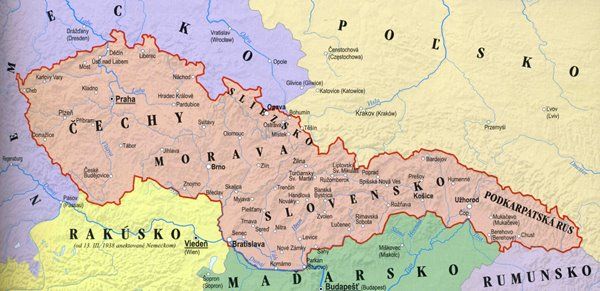
The Formation of the Czechoslovak Republic in 1918
Czechoslovak Republic in 1921
After the defeat of Austria-Hungary in the First World War, the monarchy led by the Habsburgs disintegrated. In the wreckage rose new states, including the independent Czechoslovak Republic, declared on October 28, 1918. The diplomatic and military efforts of the Czechoslovak resistance led by T. G. Masaryk on the side of the Entente against the Central Powers contributed to the recognition by the powers that won the war. The borders of the new republic were formed in complex foreign and internal political conditions.
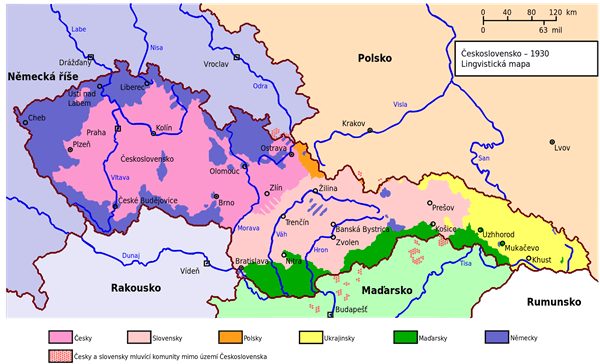
Nationalities in Czechoslovakia in 1921
- Češi – Czechs
- Slováci – Slovaks
- Poláci – Poles
- Ukrajinci – Ukrainians/Rusyns
- Maďaři – Hungarians
- Němci – Germans
- České a slovenské komunity mimo území ČSR – Czech and Slovak communities outside the territory of the Czechoslovak Republic
First of all, the new state needed to supress the resistance by the local German population in the Czech and Moravian border areas. In the meantime, a victorious conflict took place with Poland over the territory of the Czeszyn region in January 1919. War with Hungary for Slovak territories and Carpathian Ruthenia followed after those conflicts, from January through July 1919. Over time, the borders of the new state were confirmed in peace treaties with Germany in Versailles (June 28, 1919), with Austria in Saint-Germain-en-Laye (September 1919) and with Hungary in Trianon (June 4, 1920).
The new republic came into being as a multinational state. Besides Czechs and Slovaks, unrealistically declared as a united Czechoslovak nation, a strong German minority lived in Bohemia and Moravia. Meanwhile, a Hungarian minority also populated Slovakia, and the north of Moravia and northwest Slovakia was inhabited by a Polish minority. Carpathian Ruthenia was populated by Rusyns (Ukrainians, partially Russians) and a large Hungarian population in its southern part.
| Territory (km2) | Inhabitants as of February 1921 (percentage of the state’s population) | |
|---|---|---|
| Bohemia | 52,052 | 6,670,582 (49%) |
| Moravia | 22,304 | 2,662,884 (19.56%) |
| Silesia | 4,420 | 672,268 (4.94%) |
| Slovakia | 49,014 | 3,000,568 (22.04%) |
| Carpathian Ruthenia | 12,694 | 606,568 (4.46%) |
| Total | 140,484 | 13,613,172 (100%), including foreigners with the right of domicile |
| Czechoslovaks (Czechs + Slovaks) | 8,760,937 (6,760,000 Czechs and 2,000,000 Slovaks) |
|---|---|
| Germans | 3,123,568 |
| Hungarians | 745,431 |
| Rusyns | 461,849 |
| Poles | 75,853 |
| Jews | 180,855 (the total 354,342 persons with declared Jewish religion) |
Central Military Archives, Military Historical Archive, Prague