The Chinese Labour Corps and the First World War
“Even though we are working for the Allies, we are actually bringing glory to the homeland. The accomplishments of the Chinese labourers in Europe allow our nation to hold its head high.”
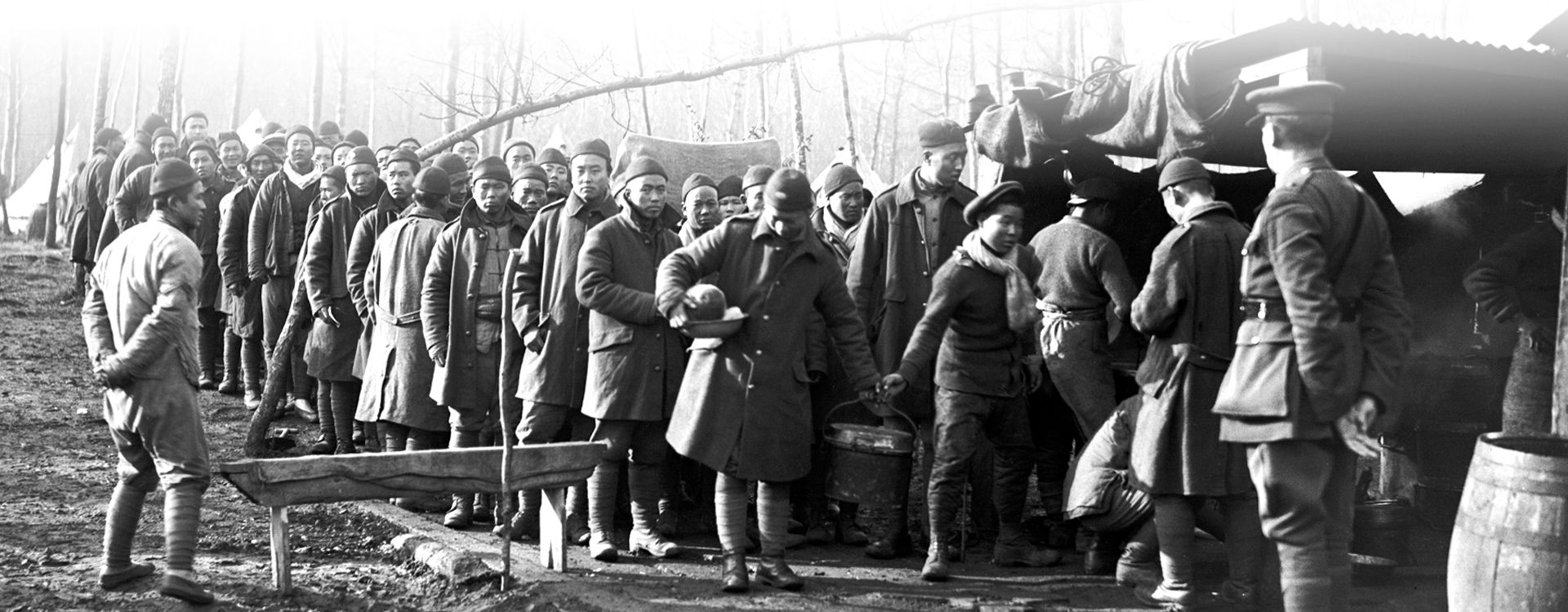
So wrote Gu Xingqing, a student who volunteered to work as a translator with the Chinese Labour Corps (CLC) on the Western Front. The members of the CLC came to the First World War with a purpose. For China, their involvement was an important signal of the nation’s engagement with the war, and proof that it deserved a place in peace negotiations. Chinese intellectuals, at the same time, had long argued that travel and work abroad were crucial if the Chinese people were to broaden their outlook. For Ma Chunling, a teacher who joined the CLC, the decision to volunteer “not only allows me to gain new knowledge … it also fulfilled my wish to travel. An opportunity of a lifetime that I cannot pass!” For the Entente nations, the purpose was less lofty: they needed workers, skilled and unskilled. The enthusiasm of August 1914 had drawn into armies all sorts of men whose work experience was scarcely valued at the time. And when so many men were killed in the early battles, armies struggled to fill the gaps. More importantly, the vast increase in armies from 1915 onward, which eventually numbered millions of young men, led to additional shortages of labour. China turned out to be a valuable source of workers.
Liang Shiyi, a senior Chinese politician, made the first overture, suggesting to the British government in 1915 that a force of military labourers (with the emphasis on ‘military’ — they were to be armed) could be provided to support the British Expeditionary Force (BEF) on the Western Front. Despite the clear need, however, the British politely declined. France was more amenable, especially when the word ‘military’ was removed from the equation, and accepted China’s proposal in the summer of 1915. Britain, soon realizing that any offer of manpower was not to be sneezed at, followed suit in August 1916. By war’s end, Britain had engaged some 100,000 Chinese men, the French some 40,000. About 10,000 of the latter were temporarily loaned to the American Expeditionary Force.
The men were not enlisted as soldiers but hired under contract as labourers, both common and skilled. Liang established a private company, under government oversight, to act as a recruiting agent for France; the British preferred to rely on their own networks in China, particularly missionaries. Pay and work hours were better under the French than the British, and the French tended to employ labourers in the rear areas and in military industries rather than at the front. For example, almost every steam crane in a French Channel port was driven by a Chinese crane operator. The BEF, in contrast, used thousands of Chinese labourers close to the front lines, despite earlier pledges that they would not work under enemy fire.
If the work and wages were worse under the British, so, too, was the racism. In relative terms, the French showed greater tolerance and decency to Chinese labourers — so much so that thousands of them, having been integrated much more deeply into French society, opted to remain in France after the war, some marrying French women and starting their own families. The British (and the Americans) were less tolerant. Yet they gave fulsome praise to the Chinese as a group — “the introduction of Chinese labour was a great experiment … [that] has succeeded, the doubters have become enthusiasts, the work accomplished has already been enormous, disputes and misunderstandings have been marvellously rare,” enthused one British report. But there is little indication that the labourer from Shandong, filling sandbags behind Arras, felt so personally valued. Yan Yangchu, a student who founded the Chinese Laborers’ Weekly in Paris in 1919, recalled how Europeans looked down on the Chinese, sometimes referring to them derisively as “coolie corpses.”
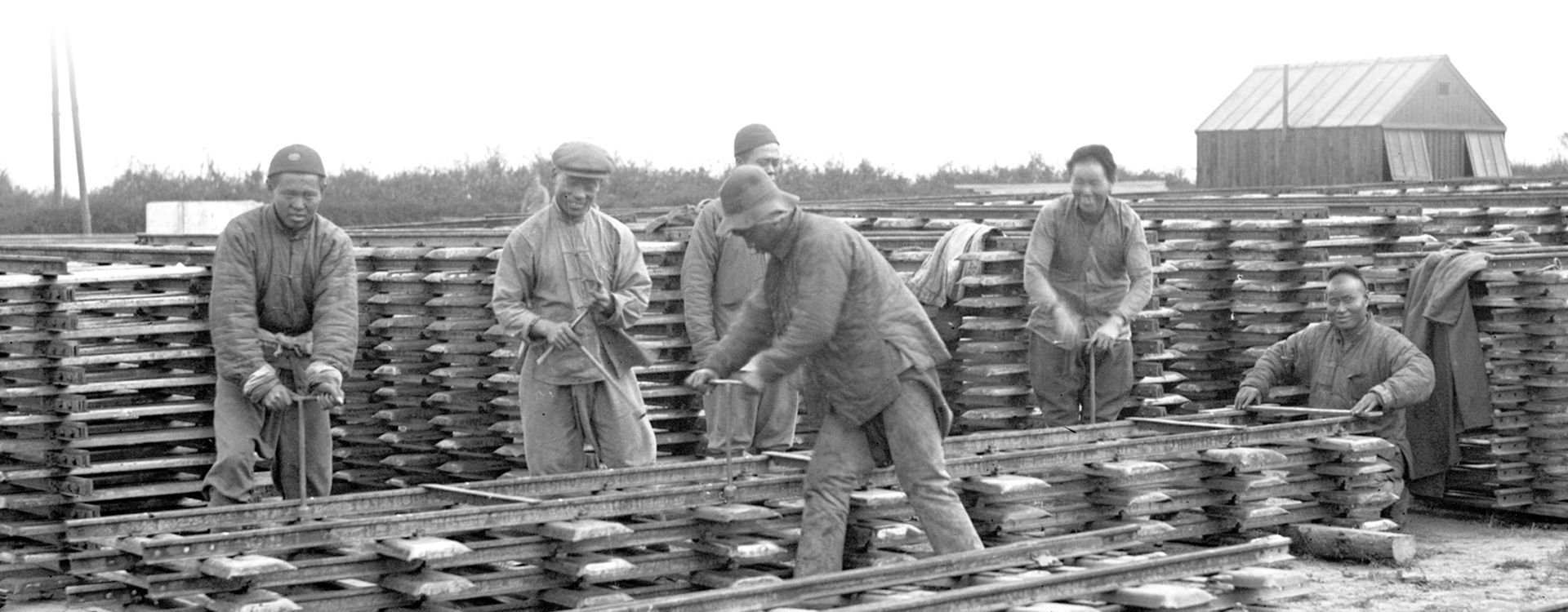
However, there is no debating their significance to the war effort. They unloaded and loaded cargo from merchant ships, rebuilt roads and railway lines, constructed huts, levelled ground for airfields and repaired tanks and artillery pieces. After the war, they were given the job of clearing the detritus of battle — rolling up barbed wire, filling in shell holes and trenches, collecting munitions and burying bodies (in spite of the widespread Chinese belief that physical contact with a dead body brought bad luck).
Whether during the war or after, it was a dangerous business. Units of the CLC were hit hard by the influenza epidemic, and the labourers also fell to a host of other diseases, from tuberculosis to beriberi. They were vulnerable to enemy bombing and artillery, and to the inevitable accidents that accompanied work with unexploded ordnance. In May 1919, after an explosion at an ammunition dump at Bailleul, Yen Tengfeng worked tirelessly and at great personal risk to prevent further blasts, and was decorated for his bravery. But beyond these generalities, much of what we know about their experiences comes to us second-hand. French, British and American officers had a great deal to say about them, and journalists were fond of imagining what they must be thinking. But aside from a few literate members of the Chinese contingents, such as Gu, the voice of the Chinese labourers is all but lost.
Their graves remain — nearly 2,000 in France, not counting the hundreds more who died on the way to or from the front. Each of the gravestones has one of three standard inscriptions: Faithful Unto Death; A Noble Duty Bravely Done; or A Good Reputation Endures Forever. Stone carvers in the CLC volunteered to stay in France on the expiration of their contracts to carve permanent headstones for the casualties. Their burial “followed the Chinese culture and coffins were used for all of them,” wrote Gu. “A cup of wine is toasted to the yellow ground, to commemorate the souls who have died in a foreign land.”
Although the Chinese labourers found themselves in an unfamiliar place on the other side of the globe, surrounded by people and events that they probably little understood, their response to the situation was likely shared by everyone else in uniform. As Gu wrote, “Those of us in Europe, we worry day and night … I thought about the problem of whether I am able to safely return to my homeland. Once I have arrived safely, I will meet again with families, relatives, and friends.… That is what each and every one of us wished for.… A million miles away at another place, we don’t know when we will see the homeland’s rivers and mountains again.”
Ya Chen Ou and Jonathan F. Vance, University of Western Ontario