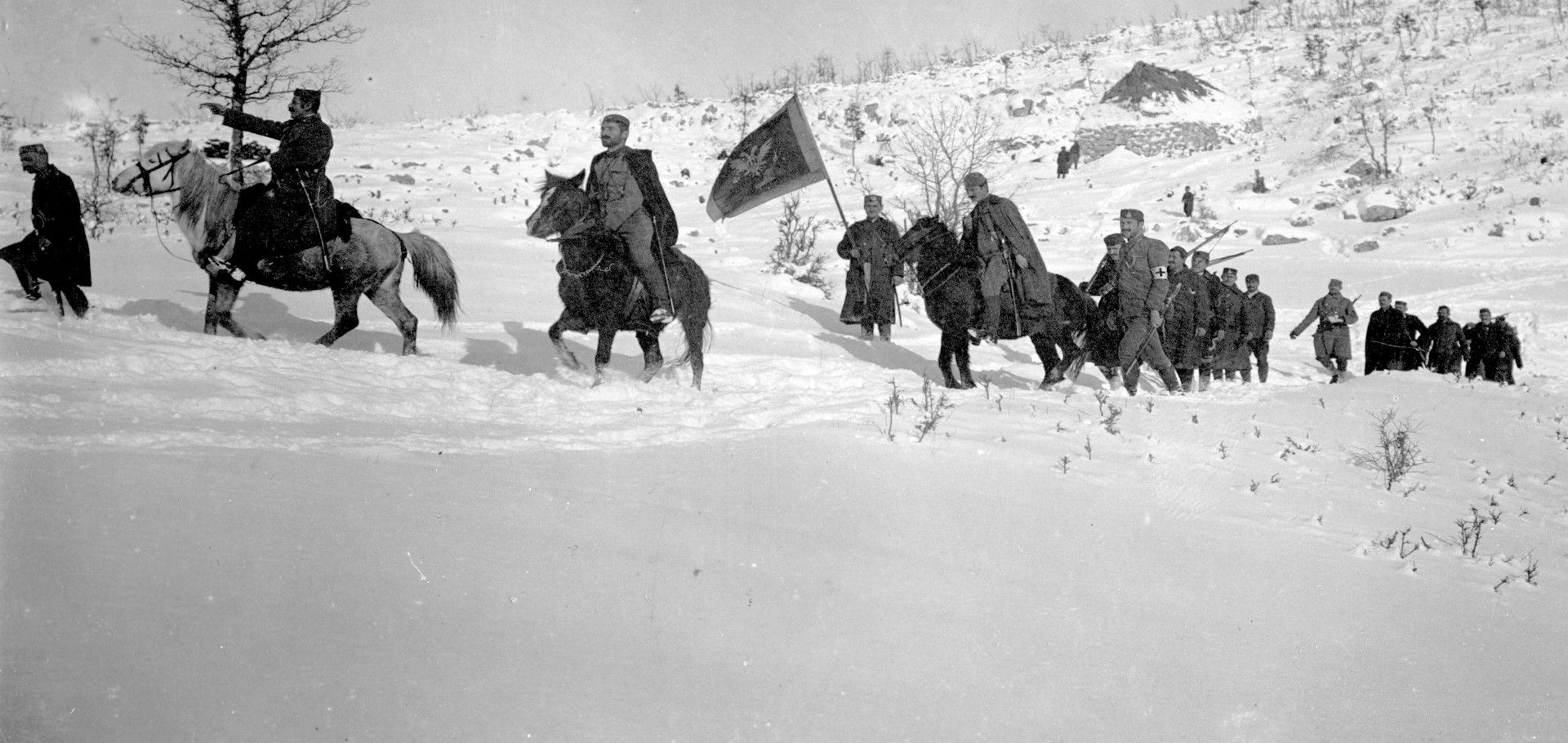
Montenegro and the First World War
On August 6, 1914 when Montenegro declared war on the Austro-Hungarian Empire, King Nikola Petrović Njegoš proclaimed to his people and his army, “You have not yet had time to wash the blood from your brave arms, when your old King is forced to call you to arms for the third time in less than two years.“ His words best describe the state of the Montenegrin army: exhausted and without having washed “the blood from its brave arms,” blood that had accumulated in the First and Second Balkan Wars. Now the army was to go into battle for a third time and against an empire that Montenegrins regarded as a world superpower. King Nikola ordered the mobilization of the army on July 28 and his proclamation was published nine days later when his nation officially entered the First World War.
The Organization of Montenegro's Army
In August 1914 the Montenegrin Army numbered 35,000 soldiers.The command and distribution of its troops was as follows:
1. King Nikola was the Supreme Commander with command headquarters in Cetinje, Montenegro’s historic capital city. Chief of Staff was General Janko Vukotić. However Serbian officers were soon stationed in Cetinje since the war against Austria-Hungary required coordination with the Kingdom of Serbia. Serb General Božidar Janković replaced Janko Vukotić as Chief of Staff.
2. The Pljevlja Division with 6,000 soldiers was commanded by Brigadier Luka Gojnić. It had the task of preventing the separation of the Montenegrin and Serbian armies in the Pljevlja region. It soon became clear that the Pljevlja Division did not have the strength to oppose the Austro-Hungarian troops, and it was reinforced on August 25, 1914 with soldiers from the other three Montenegrin detachments, transforming it into the Sandžak Army. General Janko Vukotić became its commander.
3. The Herzegovina Detachment, with 15,000 soldiers and initially under command of General Janko Vukotić, was tasked with defending the routes leading from Boka Kotorska and Herzegovina towards Nikšić. Divisional officer Mitar Martinović became the its leader when Vukotić took command of the Sandžak Army.
4. The Lovcen Detachment, with 8,000 soldiers, initially commanded by Mitar Martinović, was tasked with protecting Cetinje and the Montenegrin coast from attacks from Boka Kotorska. Prince Petar Petrović-Njegoš took command when Mitar Martinović left for the Herzegovina Detachment
5. The Old Serbian Detachment, with 6,000 soldiers and under the command of Brigadier Radomir Vešović, was to defend the border with the Principality of Albania.
Montenegrin Troops Support Serbia's Uzice Army
The Montenegrin Austro-Hungarian field of engagement stretched for 380 kilometers through southeastern Bosnia, Herzegovina, Boka Kotorska and Montenegro. The defensive front held by Montenegrin units was 500 kilometers long. At the beginning of the war, the position of the Entente, primarily of Russia, was that Montenegro’s army would coordinate with the operations of the Serbian Military Command. This resulted in changes of Montenegro’s strategic plan and the deployment of its troops. As part of Montenegro’s initial plan the majority of its army had been assigned to the Lovcen and Herzegovina fronts. They were now redeployed to Sandžak to achieve Serbia’s military goals. On August 21, 1914 Serb General Božidar Janković took over Montenegro’s Supreme Command. King Nikola formally remained in command but the actual command was in the hands of Serbian generals. This resulted in two thirds of Montenegro’s troops being concentrated in the region of Pljevlja, in order to assist the Serbia’s Uzice Army.
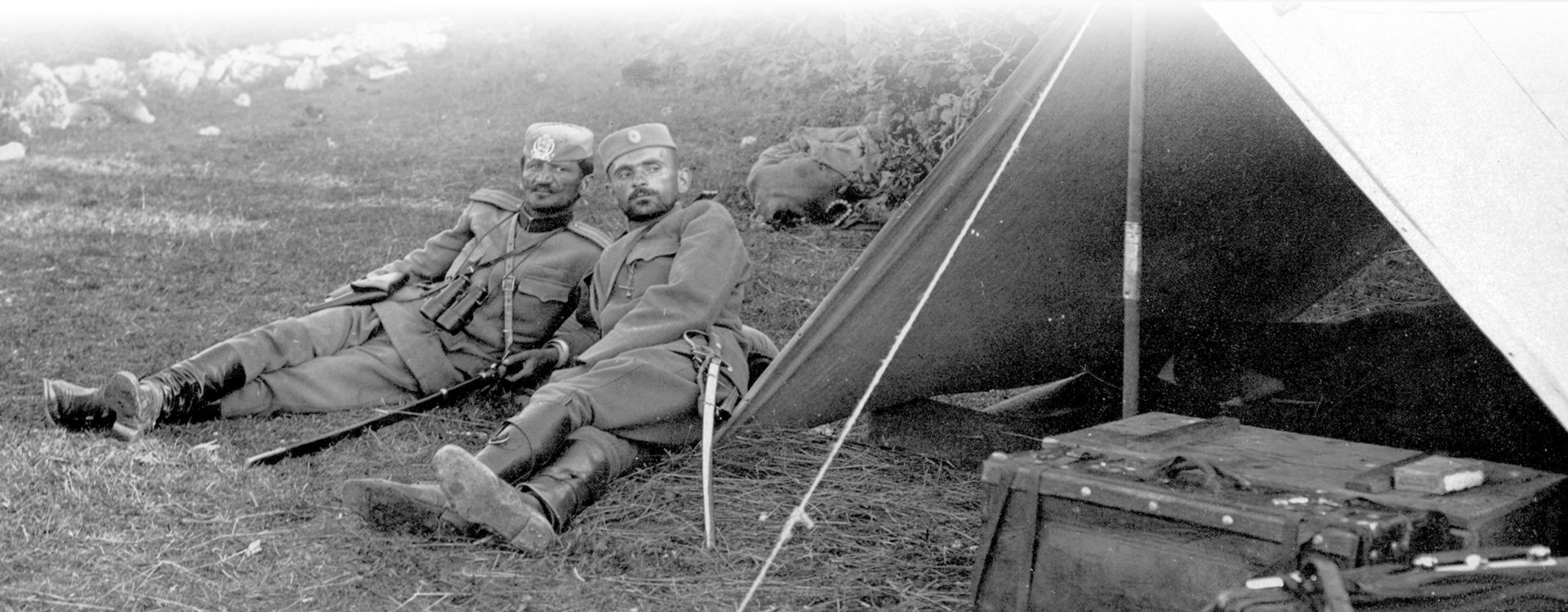
The Lovcen Detachment
Between August 6 and 15, 1914, after the declaration of war, Austro-Hungary withdrew its troops from the narrow coastal strip from Prcja Glava to Spic, being unable to mount a defense there. Montenegro’s Lovcen Detachment then occupied Grbalj, Budva and Pastrovici. On August 16, the French fleet sank the Austro-Hungarian cruiser SMS Zenta, while three other warships managed to escape. The Austro-Hungarians retreated to Boka Kotorska where they had built a system of fortifications. At that time, a detachment of 196 French soldiers arrived in Cetinje along with a number of cannons and machine guns. The French artillery was moved to Lovcen, where it began to bombard the Austro-Hungarian fortresses and fleet. The plan was to conquer Boka Kotorska, which represented Austro-Hungary’s first line in the defense on the Dalmatian coast. For months a fierce artillery duel was fought between the Austro-Hungarian and Montenegrin-French guns. But by the end of November 1914, with the first snow appearing on Mount Lovcen, the Montenegrin-French forces had not achieved any significant success and the objective of conquering Boka Kotorska was abandoned. The last French soldier was withdrawn from Lovcen on November 23. The military positions on this section of the front remained unchanged until January 1916.
The Herzegovinian Detachment
In the first days of the war the Herzegovinian Detachment fought successfully in the vicinity of Trebinje, Bileca and Gacko. They prevented the advance of Austro-Hungarian troops and by the end of August 1914 had facilitated the regrouping of the Montenegrin forces and the creation of the Sandžak Army. Austro-Hungary attacked again in late August and fighting lasted until September 6 when the attack failed. In October, the Herzegovina Detachment was in action around Gacko and Bileca in an unsuccessful attempt to conquer these locations. An Austro-Hungarian counterattack followed till mid-November that was also unsuccessful. Hostilities on this part of the front, excluding reconnaissance activities, were then paused until July 1915. Austro-Hungarian troops then tried once more, without success, to break Montenegrin defenses and penetrate to Grahovo. There followed another lull until October 1915 when a combined Austro-Hungarian-German military offensive would begin.
The Pljevlja Division
On August 15, 1914, Austro-Hungarian forces from Gorazde and Foca attacked Montenegro’s Pljevlja Division. Due to Austro-Hungary’s advantage in both men and armaments — 5 to 1 in troops and 16 to 1 in terms of artillery — the Pljevlja Division found itself on the defensive and subsequently retreated. By August 19, Austro-Hungarian troops had entered Pljevlja, the largest city in this region of Montenegro. Their advance however was halted after the Serbian army was victorious at Cer and on August 23 after which the Austro-Hungarians retreated from the areas they had taken.
The Sandžak Army and The Lim Division
The unfavorable situation in Sandžak led to changes in Montenegro’s command staff. The Sandžak Army was subsequently formed, led by General Janko Vukotić, and after pushing the Austro-Hungarians back across the border, it then went on the offensive. By September 8, 1914 the Montenegrins had occupied Foca and gained the east bank of the Drina River. Continuing their advance towards Kalinovik, parts of the Herzegovina Detachment from which the Drina Detachment was formed, arrived to assist the Sandžacki army. The offensive in southeastern Bosnia continued from September 15 to October 25, assisted by the Serb Uzice Army. After the conquest of Gorazde, the advance continued towards Rogatica which fell on September 17, 1914. Montenegrin troops were now fifteen kilometers from Sarajevo. There followed a break in the fighting until October 9 when Austro-Hungarian attacks on the Sandžak and Serb Uzice armies began. Heavy fighting followed and by October 21 near Glasinac the left wing of the Sandžak Army was broken. It then began a retreat until October 24. The Sandžak Army troops and the Drina Detachment then took up positions on the west bank of the Drina River. In these battles, the Montenegrins had lost more than eleven percent of their forces — 468 dead and 1,203 wounded. In order to protect the right flank of the Sandžak army, the Lim Division was formed which was to guard the west bank of Lim River, from Visegrad to Priboj. It was this division that in the Battle of Kolubara (November-December 1914), successfully defended the rear of the Serbian Army and captured Visegrad on December 12. After the Serb victory at Kolubara, activity paused in this sector from January to October 1915, and once again the Lim Division became part of the Sandžak Army.
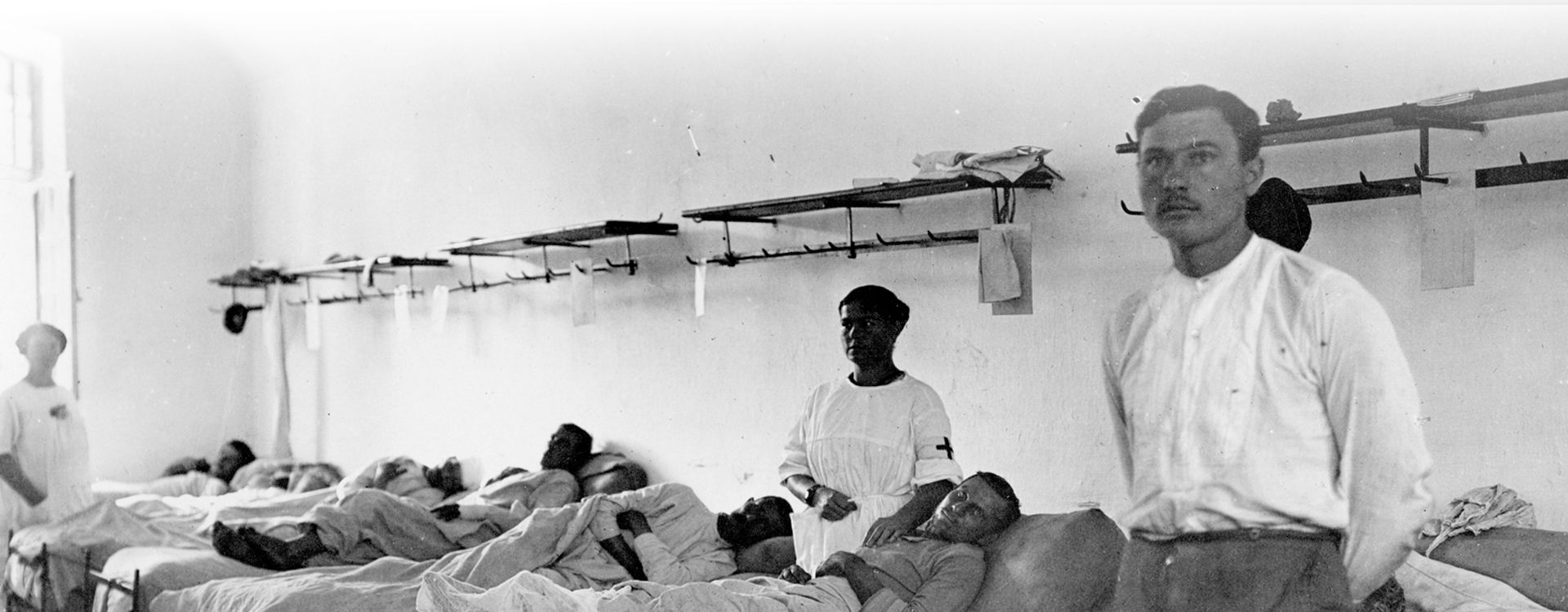
The Old Serbian Detachment and the Albanian Border
As a result of Austro-Hungary’s political agitation in Albania and the arming of Albanians along the border, the Montenegrin command formed the Old Serbian Detachment to guard its border with Albania. which ran for 180 kilometers from Lake Skadar, through Prokletije all the way to Kosovo and Metohija. Since the Old Serbian Detachment lacked sufficient soldiers to guard the entire border, armed civilian groups were formed in Tuzi, Plav-Gusinje, Rozaje, Pec, Djakovica, and at other locations close to important border crossings. This enabled a rapid response in the event of Albanian advances. Immediately after the declaration of war, incursions by Albanian bandits — kacaks — had begun, but Montenegrin forces had managed to repel them. In addition to territorial incursions, the kacaks also threatened Montenegro’s supply line on Lake Skadar by attacking Montenegrin shipping that transported food and other necessities. The most significant damage was inflicted in June 1915, when two million kilograms of grain in the port of Medova intended for Montenegro was stolen despite the Montenegrin government having promised to donate 200,000 kilograms of grain to Albania’s population.
These actions by Albania led the Montenegrin government to consider seizing Shkoder and the bordering Albanian towns. Such actions were demanded by those who had not forgotten that because of political pressure by the major powers, Montenegro had to leave Shkoder in the 1913 Balkan War and hand it over to Albania, the previous conquest of which Montenegro had paid a high price in terms of casualties. The Montenegrins occupied parts of Albania in June 1915 after the Serbian army, without informing Montenegro, had crossed the Serbian-Albanian border and occupied Elbasan and Tirana. Accordingly, on the orders of King Nikola and without the knowledge of Serbian officers, on June 8, 1915 the Old Serbian Detachment launched an attack and by June 28 had entered Shkoder and Medova. The Albanian incursions stopped after this occupation and the flow of food and other necessities was normalized.
Members of the Entente condemned Montenegro’s unilateral action and did not recognize its occupation of Shkoder and Medova. Serbia also disappoved despite the fact that Montenegro’s incursion into Albania had diverted attention from a similar action by the Serbs. As a result of the occupation, Janković resigned as Chief of Supreme Staff and Colonel Petar Pešić was appointed in his place. Before leaving, Janković went to the United Kingdom’s embassy to announce his conviction that King Nikola had made a secret agreement with Austria-Hungary. This accusation cast serious doubt over Montenegro’s loyality to the Entente, even though Janković’s accusation was later proven to be a false. In the 1950s the Military History Institute in Belgrade twice asked the Vienna State Archives for First World War documents on agreements between Montenegro and Austria-Hungary, and twice it was informed that such documents did not exist. Nevertheless, though the Shkoder crisis was militarily successful since it ended the Albanian incursions, it produced mistrust among the Entente towards Montenegro.
The Austro-Hungarian-German Offensive of 1915
The Austro-Hungarian-German offensive against Montenegro and Serbia began October 5, 1915. The Bulgarian Empire joined the attack eleven days later. As the offensive began, the Montenegrin army had 48,000 troops. Morale and discipline was high and the army’s structure was unchanged from December 1914. Approximately 51,000 Austro-Hungarian troops faced them. For two weeks no major battles occurred on the Montenegrin front but on October 22, 1915 Montenegrins came under attack as units of Austro-Hungary’s 62nd division established a bridgehead in the Visegrad region. From then until January 1916, the fighting was continuous. The Sandžak Army held its positions until mid-November when Supreme Command ordered a staged retreat towards positions within Montenegro. The Montenegrin’s task was to protect the Serbian army’s withdrawal to the Adriatic Sea, since Bulgarian forces had blocked the Serb retreat to Greece via Macedonia. The Sandžak army thus assumed the role of protector of the Serbian army. The fiercest fighting took place between the Lim and Tara Rivers. As a result, the Austro-Hungarian troops arrived at the Tara River only in mid-December and were prevented from crossing. This thwarted their goal of threatening the withdrawal of Serbian troops towards the Adriatic Sea. The Austro-Hungarian attacks continued into January of 1916. First Berane fell on January 5, and during Orthodox Christmas, January 6 and 7, fighting was around Mojkovac. It was there that the Montenegrins defeated the Austro-Hungarians, which proved to be their most significant victory in this war. The Austro-Hungarian General Franz Konrad von Hetzendorf acknowledged the determination of the Montenegrins when he said, “We fought against heroes from a fairy tale”.
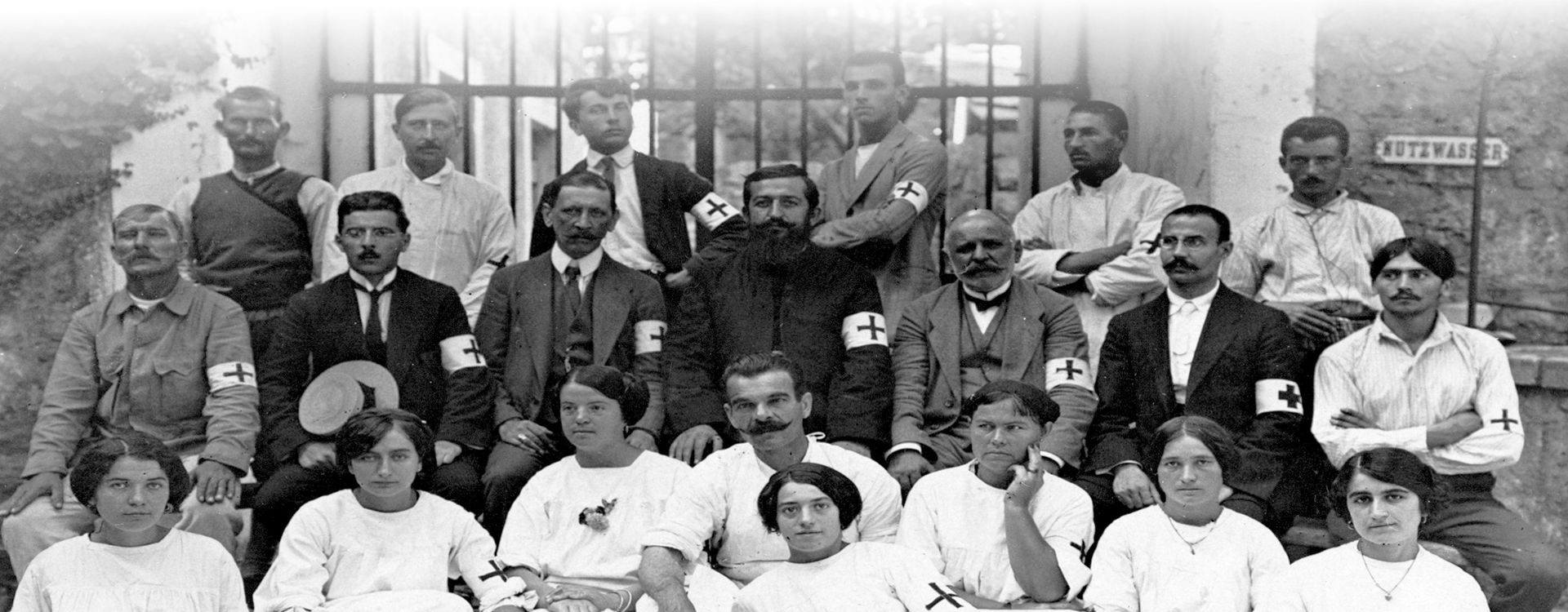
The Austro-Hungarian-German Offensive on the Lovcen and Herzegovina Fronts
At the beginning of the offensive in October 1915, the Lovcen and Herzegovina front didn’t see much combat. However in early November the Austro-Hungarian army endeavored, without success, to break through the Herzegovinian front near Grahovo. Extensive combat on this section only began in late December, 1915. The main attack was in the Lovcen area because it offered a direct route to conquering Cetinje, the Kingdom’s historic capital. Austro-Hungary had a 6 to 1 advantage in troops, and 12 to 1 in artillery. The attack on Lovcen began on the day of the victory at Mojkovac. The Austro-Hungarian fortresses and fleet in Boka Kotorska Bay opened heavy fire on the Montenegrin positions, while their troops began to advance along the steep slopes of Mount Lovcen. A symbol of Montenegrin freedom, Lovcen fell on January 12, 1916 and the Austro-Hungarians entered Cetinje the next day. King Nikola first retreated to Podgorica, and by January 19 he had arrived in Shkoder from which he journeyed first to Medova and finally to Italy.
Montenegro’s Armistice, Occupation and Resistance
On January 21, 1916 the Montenegrin government, reduced to three ministers, made the decision to disband the army. On January 25, an armistice with the Central Powers was signed. The Kingdom of Montenegro had essentially capitulated, although from a formal and legal point of view only King Nikola could conclude a peace.
The Austro-Hungarian authorities formed the Military General Governorate, which kept Montenegro under occupation. To maintain order, Austria-Hungary stationed 40,000 soldiers in the country, a concentration of troops rarely seen elsewhere. The occupiers enacted a brutal policy and Montenegrins suffered daily poverty and humiliation. People ate bark from trees, cooked nettles and other herbs, while epidemics raged. However by mid-1916, the komite insurgent movement carried out actions against the occupiers, resulting in Austro-Hungarian forces executing approximately 500 Montenegrins while 9,500 others were interned in camps. In the political turmoil of 1918, Austro-Hungarian sailors in Boka Kotorska, on the warships SMS Sankt Georg and SMS Gea, revolted. 6,000 demanded an end to the war, better food and regular leave. Influenced by the Bolshevik revolution in Russia, they had developed a red flag. Their mutiny was put down in three days and authorities executed four sailors.
The Loss of Independence
The liberation of Montenegro from Austro-Hungary began with the Entente’s breakthrough of the Macedonian front in September 1918. Montenegrin komite insurgents intensified their actions and an armed uprising took place. Most cities were liberated but the Serbian army was only involved in the liberation of Podgorica at the end of October.
At war’s end, the Serb Supreme Command ordered the insurgent detachments to be disbanded, and the process of uniting Montenegro with Serbia began. This resulted in the illegitimate and illegal Podgorica Assembly of November 24 to 29, 1918, that made the decision to unconditionally unify Montenegro with Serbia. In addition, the Podgorica Assembly deposed King Nikola and his dynasty.
During the First World War, the Montenegrin army suffered approximately 20,000 casualties — dead, wounded and missing. This loss represented ten percent of the country’s 1912 population. Material losses were estimated at 723 million francs. However, the greatest loss was the disappearance of the Montenegrin state with its submergence in the new Kingdom of Serbs, Croats and Slovenes. The manner in which Montenegro lost its independence was best described by Lord Sydenham: “I am now most sincerely asking for some sympathy for Montenegro, our smallest ally, which would have fared much better if it had declared its neutrality during this war, and would not have fared worse even if it had been on the side of our enemies!”
Filip Kuzman, Director, National Museum of Montenegro