Greece and the First World War
On June 15, 1917 Greece officially entered the war on the side of the Allies (the Entente Cordiale) and against the Central Powers that included the Ottoman Empire, Germany and Bulgaria. Prior to the war, Greece was in a period of vacillation between the political forces that wished to remain neutral and those who forcefully wanted to enter the war on the side of the Entente. The situation was intensified by the direct and indirect pressure brought by the two belligerent alliances to join them. Greece’s political factions either rallied around King Constantine I who supported neutrality, or those that wanted to join the Entente, represented by Prime Minister Eleftherious Venizelos. The rivalry led to a prolonged schism in Greek society and created a national divide which plagued the nation throughout the war and into the post-war period, especially during the Asia Minor Campaign of 1919-1923 and the resulting catastrophe. Greece’s participation in the 1914-1918 war must therefore be considered in its wider political context rather than only as a straight forward military confrontation.
Political Challenges Before the First World War
Greece had just emerged victorious from two Balkan Wars: the first in 1912-1913 against the Ottoman Turks and the second against the Bulgarians later in 1913. Greece’s victories led to an almost doubling of its territory and its population. To the “old” Greece were added the “new” countries of Epirus, Macedonia, Crete and the Aegean Islands, which had been liberated by the Hellenic army and navy. This had been achieved with relatively limited losses — around 52,105 combat casualties of all kinds, including 8,143 killed in action. Normally the country would then have concentrated on the administrative, economic and social assimilation of the “new” countries but the revanchist desire of the Balkan War losers, Bulgaria and the Ottoman Empire, that wished to recover the lands they had recently lost, drew Greece’s attention to matters of security. The threat of a Bulgarian resurgence forced Greece to coordinate with the other victorious Balkan countries, Serbia and Romania, which were similarly threatened by Bulgaria in Macedonia and in Dobrudja (south of the Danube Delta) respectively.
The threat to Greece from Ottoman Turkey was more serious. Greece remained committed to the 1,500,000 Orthodox Christian compatriot Greeks, who still resided as Ottoman subjects within the territories of the Ottoman Empire. They lived mainly in Eastern Thrace (“European” Turkey), in Constantinople (modern Istanbul), on the southern shores of the Sea of Mamara (Bithynia), on the eastern shores of the Aegean Sea (Ionia) and the southern shores of the Black Sea (Pontus). In addition, Ottoman Turkey did not accept the loss of the eastern Aegean islands, attributing its naval defeats to a fortuitous “window of opportunity” that the Greeks had taken advantage of after the modern armoured cruiser Georgious Averof, which was superior to the older Turkish battleships, had been added to the Greek fleet.
Following the second Balkan War, Greece and Turkey engaged in naval arms race as a possible third Balkan war loomed that could decide who controlled the Aegean Sea. Early in 1914, the Turks had begun the persecution of Greeks in the Ottoman Empire, evicting them from the shores of the Aegean in Asia Minor. It is estimated that before the outbreak of the First World War, more than 153,890 Greeks had been persecuted, displaced from their homes or even killed in a precursor of the Armenian genocide that was to take place the following year. By 1917, that number had risen to over 750,000. Up to 150,000 of the persecuted Greeks from the Ottoman Empire had fled as refugees to liberated Greece, adding yet another economic and social problem to Greece’s existing ones.
The danger of a Greco-Turkish war was averted by the unexpected outbreak of the First World War at the beginning of August 1914 between the Entente and the Central Powers. Great Britain had seized two modern dreadnought battleships which had just been built in England on behalf of the Turks, and enrolled them in her fleet. This action, among other factors, led the Ottoman Empire to align itself with the Central Powers and then, a few months later, enter the war against the Entente. In the short term however, the loss of the battleships essentially disarmed the Ottoman Navy and thwarted any plans the Ottoman’s might have had to regain naval supremacy in the Aegean Sea.
Greece’s Neutrality in 1914-1915
Following the declaration of war Greece remained neutral, as indeed did its neighbouring countries, since the fighting in the Balkans was initially limited to Austria’s attack on Serbia, to the north west of Greece. However, after the Ottoman Empire entered the war on October 29,1914, the region’s fragile balance was disrupted and a complex succession of diplomatic actions followed, at times emanating from Prime Minister Eleftherious Venizelos and at times from King Constantine I. Their diplomatic machinations included the Entente, the Central Powers, Serbia and Romania. In this, the key factor was Bulgaria joining the Central Powers on September 6, 1915. The Allies felt compelled to support Serbia which was now being threatened from the east.
Thus on September 30, 1915, the Allied fleet appeared in Thessaloniki (then known as Saloniki) and upon consultation, Venizelos gave his permission (without the approval of the King or the Parliament) for the Allies to land in Thessaloniki on October 5, 1915. Initially it was France’s 156th Infantry Division and shortly after two more French and one British division arrived. All of these forces subsequently passed through Greek territory and into Serbian Macedonia. But on the same day, despite the fact that the Parliament had voted in favour of Greece’s entry into the war, the King dismissed Venizelos and assigned Alexander Zaimis as Prime Minister. Elections from which Venizelos’ party abstained were called in November, and a new government was formed under Stefanos Skouloudis. From then until Greece’s entry into the war in 1917, the government remained rigidly committed to neutrality. The Allies, now firmly ensconced on Greek soil, began to exert strong pressure on Greece to formally side with them.
Neutral Greece and the Macedonian Front 1916-1917
On October 5, 1915 Austrians, Germans and Bulgarians attacked Serbia. By December 17, the Serbian Army had been defeated on all fronts and was cut off from the Allied forces, which, coming from Thessaloniki, had tried to provide assistance in Serbian Macedonia. The defeated Serb forces eventually journeyed through Albania to the eastern shores of the Adriatic. There, Allied ships transported the emancipated remnants of those forces to the Greek island of Corfu, which the Allies had occupied for this purpose despite the protests of the neutral Greek government. Later, other Greeks islands were also occupied under various pretexts. About 120,000 surviving Serbian soldiers were reorganized in Corfu into six infantry divisions and transferred to Thessaloniki in April-May 1916.
In the meantime, the four Allied divisions that had entered Serbian Macedonia, having failed to overcome the Bulgaria resistance, re-entered Greek territory. The Bulgarians, on orders from the German Chief of Staff von Falkenhayn, stopped at the Greek border and did not follow them. Shortly afterwards, the Allies created a wide entrenched “fortified camp” around Thessaloniki, inside which nine divisions were gradually assembled under France’s General Maurice Sarrail, commander of the Army of the East (L’Armée d’Orient). Before the end of 1915 Allied forces in Thessaloniki exceeded 150,000 men. Upon arrival of the Serbs, Allied forces reached 300,000, and troops left the entrenched camp and deployed inside Greek territory, opposite the Bulgarians, from the Strymonic Gulf (in the east) to Axios (Vardar) River. The neutral Greek forces, mobilized since September 1915, withdrew from the area and gathered on either side of the Allies: Greece’s 4th Army Corps in Eastern Macedonia, beyond the Strymon (Struma) River, and the 3rd Army Corps to the west, from Thessaloniki to Florina. On May 26, 1916, the Bulgarians advanced ten kilometers into Greek territory and occupied the Rupel Fort (which controlled the Strymon valley) without a fight, since the Skouloudis government had allowed Bulgaria to do so as a counterweight to the Allied presence in Greek Macedonia. As a countermeasure, General Sarrail declared martial law in Thessaloniki and took control of practically all activities in the city, especially the railway. On June 9, the Allies delivered an ultimatum, inter alia, demanding the demobilization of the Hellenic Army, a change of the police leadership, the dismissal of the Skouloudis government and the announcement of new elections. The King accepted their demands. The Greek Army was demobilized in July 1916, Zaimis succeeded Skouloudis as prime minister, and the Allies largely lifted their blockade.
By mid-August, one Italian division and the equivalent of one Russian division had been added to the Allied troops at Thessaloniki. There were plans for a major allied offensive to the north, as Romania prepared to enter the war on the Entente side (Romania joined the war on August 27, 1916, but was crushed within three months by the Central Powers and two thirds of its territory was occupied). The preparations were, however, pre-empted by a Bulgarian attack in two directions inside Greek territory on August 17, 1916: to the west, the Bulgarians occupied Florina and to the east, Eastern Macedonia. The Greek cities of Serres, Sidirokastro, (then known as Demir Hisar), Drama and Kavala were captured without facing resistance by the demobilized Greek 4th Army Corps. The losses were considerable: 464 officers and 6,373 soldiers of the 4th were apprehended by the Germans, who accompanied the Bulgarians, and were transported as “guests” to the town of Görlitz in Silesia, where they remained until the end of the war. Another 2,000 Greek soldiers, who refused to surrender, boarded allied ships and fled to Thessaloniki.
The occupation of Eastern Macedonia led to the formation of the National Defence Movement in Thessaloniki, a movement that had been mulled over by Venizelos’ supporters since spring in collaboration with the French. On August 30, 1916 the newly established “Macedonian Self-Defence Committee” rebelled against the royalists in Thessaloniki, causing a standoff. General Sarrail intervened in favour of the Committee and expelled the troops that remained loyal to the Greek King. On September 1, 1916 an oversized French naval squadron of seventy ships (ten of which were battleships) anchored in the Gulf of Salamis in front of the port of Piraeus to threaten the royal government, which in the eyes of the Allies had completely lost its credibility. From then on the Allies generally worked, with varying degrees according to their interests, towards replacing King Constantine I on the throne.
The Declaration of War in June 1917
Immediately following these events, Venizelos, Admiral Pavlos Kountouriotis and General Panagiotis Danglis representing the “Provisional Government” in Thessaloniki which had the support of the Allies, declared war against the Central Powers. Greece was thus divided into two hostile states: one in Athens maintaining a neutral stance, while the other in Thessaloniki was participating in the war on the side of the Allies. This disarray ended only after the Allies inflicted multiple humiliations upon the Athens state, including the forced evacuation of Thessaly, Epirus, and the Ionian Islands, the confining of the army to the Peloponnese, and the surrender of the light fleet and field artillery to the Allies. There also had been bloody skirmishes on the outskirts of Athens with Allied landing parties, as well as the bombardment of the capital by the Allied fleet in November 1916. Above all else, the winter of 1916-1917 was a period of acute hunger and other trials for the Athenians. The Allies, in retaliation for the November skirmishes, blockaded the capital by land and sea, cutting it off from food and other supplies.
On June 1, 1916 King Constantine, following an Allied ultimatum, had been removed from Greece and replaced by his second son Alexander. On June 14, 1917 Venizelos formed a government in Athens and declared that Greece was at war with the Central Powers. Under these seminal albeit tragic conditions for the Greeks, the Hellenic Armed Forces would appear again on the Macedonian Front battlefields to make their presence felt until the end of the war.
Greece’s Participation in the Great War: 1917-1918
At the beginning of May 1917, General Sarrail launched an attack on the sectors of Doiran, Skra and the Dobro Polje-Cerna (Erigon) River. In the Huma-Skra sector, the Greek Serres Infantry Division participated in the attack. This was one of the three divisions — Serres, Archipelagos and Crete, belonging to the National Defence Army Corps — formed by the Provisional Government in Thessaloniki. The men fought bravely and succeeded in capturing the Raviné and the Chemin de Fer heights to the south of the town of Gevgelija. However the wider allied attack failed, incurring heavy losses. In the meantime, after the unification of the Greek state in June 1917, the Venizelos government, after months of hard work, formed and trained seven new infantry divisions (nos. I, II and XIII of the 1st Army Corps, and nos. III, IV and XIV of the 2nd Army Corps, as well as the IX from Epirus), and thus in the spring of 1918 the Hellenic Army had a strength of ten divisions.
By the end of May 1918, the National Defence Army Corps, with Serres, Archipelago and Crete divisions under its command, took important offensive action to eliminate the strongly fortified Bulgarian presence at Skra. In the following Battle of Skra-di-Legen, the main attack was by the Archipelago division on May 30, 1918 after a 24-hour preparatory bombardment by over 120 guns. The battle was fierce and the losses were significant with 450 Greeks killed in action and 2,200 wounded. But the Greek forces prevailed, taking and holding the enemy position while capturing 2,000 Bulgarian prisoners, thirty-two guns and twelve trench mortars. With the victory at Skra, the Hellenic Army regained its good reputation in the eyes of the Entente. Moreover, this was the first successful allied offensive in this theatre of the war since the fall of Monastir in November 1916.
In June 1918, the Macedonian Front was situated from west to east, on the line of Verati–Ohrid–Prespa–Monastiri–Doirani–DovaTepe–Lake Achinou–Strymonikos Gulf. A total of twenty-nine allied divisions (eight French, four British, six Serbian, one Italian and ten Greek) were lined up on this front under the command of the new French commander-in-chief General François d’Espèrey. Against these forces, totalling 289 Infantry Battalions, the Austro-German-Bulgarians deployed four armies with a strength of 263 Infantry Battalions, leaving the Allies with a small numerical superiority. The final allied offensive plan called for a strong artillery preparation in the Skol-Vetrenik mountain sector and an eight division attack in two echelons on the Kozjak-Gradsko-Skopje (Uskub) axis.
Secondary attacks would be made on Lake Dorian and the Strymon Valley to mislead the enemy and pin down its reserves. On September 14, 1918, the Allied attack was launched after a daylong artillery barrage from 570 guns, as well as the intervention of the entire Allied air force available in the theatre. Within the first days, a breach was cut twenty kilometres wide and eight kilometres deep in the Bulgarian front. The 35th Greek Infantry Regiment participated in the main attack. On September 18, a secondary Allied advance on Dorian was launched by two British and two Greek divisions, but with little success, except for pinning down the enemy reserves, which remained an important objective. On that same day a complete breakthrough of the German-Bulgarian front was achieved at Mount Kozjak, followed by a rapid exploitation by the Allies along the Alexios valley. Thus began a general advance inside the territory of Serbia and all ten Greek divisions took part in this pursuit. No. III division, eventually got as far as the Danube River, thus participating in the complete expulsion of the enemy from Serbian territory. Under these conditions, and while the Bulgarian Army was essentially disintegrating, Bulgaria requested an armistice on September 26, 1918, and subsequently laid down its arms. Turkey did the same on October 30, with the Armistice of Mudros signed on the Greek island of Lemnos, which brought the cessation of hostilities and surrender of its military forces.
Greece’s Military Casualties
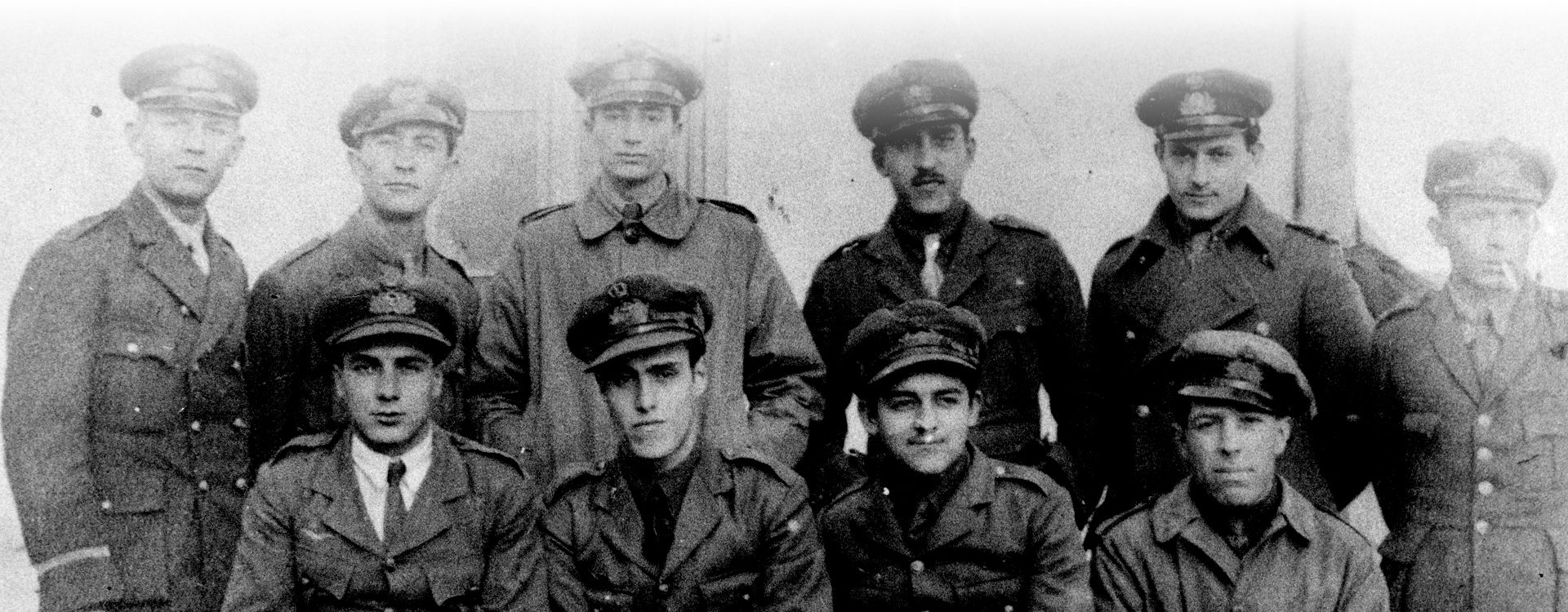
During the breakthrough battles of the Macedonian Front Greek losses totalled 5,259 men of which 773 were killed in action. This meant that during this final battle the Hellenic Army contributed thirty-four percent of the Allied forces and suffered half of the Allied casualties. However this was not the only contribution of the Hellenic Forces. Of the losses of Allied merchant ships in the Mediterranean, the Hellenic merchant fleet suffered the greatest number. The Hellenic light war fleet had largely covered for the lack of Allied destroyers in the eastern Mediterranean and proved capable in anti-submarine warfare. Its most effective ships, the “Aetos” class destroyers, distinguished themselves in the Dardanelles patrols. In addition, the Hellenic Air Force — divided into the Army Air Force and the Naval Air Service — also came of age during the war. The Army Air Force actively participated in the Macedonian Front through its three squadrons (nos. 531 to 533) with forty-five aircraft. In turn, the Greek Naval Air Service distinguished itself in operations over Macedonia and the North Aegean from air bases in Moudros of Lemnos, Stavros of Chalkidiki, and Thasos and Legraina of Attica. In 1918 the Naval Air Service expanded to four Squadrons nos. H1 to H4, (H=Hellénique.) Among the feats of its crews were the destruction of three enemy ammunition trains at Drama on March 31, 1917, and the recurring bombardment of German cruisers Goeben and Breslau registered under the Ottoman flag on January 20, 1918 in the Dardanelles, which rendered the ships inactive. During aerial dogfights above enemy ships, the pioneering Greek aviator Commander Aristeides Moraitinis, a veteran of the Balkan wars, though heavily outnumbered, shot down two enemy aircraft. In 1918 Moraitinis, Greece’s only war ‘ace’ was killed in a crash in bad weather conditions near Mount Olympus. Fourteen other Greek airmen also lost their lives in the war.
Greece’s participation in the Allied war effort in Macedonia and the Aegean with strong naval and air forces, ultimately earned it a seat at the victor’s table at the Paris peace negotiations in 1919, where Venizelos promoted Greece’s claims to Thrace and Asia Minor. The First World War’s human cost for Greece was 23,564 soldiers and 496 officers either killed, missing in action, or perished from wounds and — especially — epidemic diseases.